
Affordability concerns will mean more uninsured and provider pains
The Congressional Budget Office (CBO) recently released an updated projection on healthcare coverage and the news in the short and long term is not good. The uninsured rate could surge and undermine healthcare stability.
In a July 23, 2026 publication on federal subsidies for health insurance, the CBO had a few interesting projections:
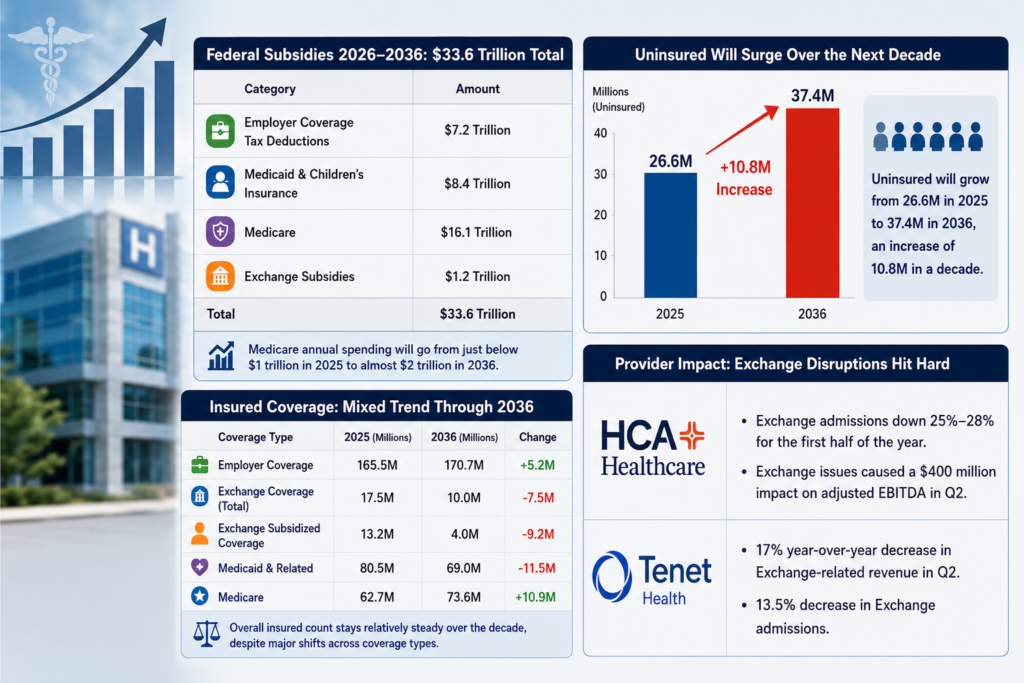
- Total federal subsidies from 2026 to 2036 will be $33.6 trillion. About $7.2 trillion, just over a fifth of the total, will be for the employer coverage tax deductions. Medicaid and children’s insurance will amount to about $8.4 trillion, or a quarter. Medicare will amount to $16.1 trillion, or almost one-half. Medicare annual spending will go from just below $1 trillion in 2025 to almost $2 trillion in 2036. Exchange subsidies will be about $1.2 trillion.
The numbers show that costs will continue to surge and demand more and more government expenditures or tax deductions. Increases will result from growth in enrollment, prices, and service intensity. For example, subsidies for Medicare are projected to nearly double over the next decade, increasing by about $900 billion, or 86%. From 2026 to 2036, total federal subsidies are projected to increase by about 1 percentage point as a percentage of GDP.
- The number of uninsured will grow from 26.6M in 2025 to 37.4M in 2036, an increase of 10.8M in a decade. The overall insured count stays steady over that decade, with employer coverage jumping just 5.2M from 165.5M to 170.7M. Insurance purchased on the Exchange will drop 7.5M, with subsidized coverage dropping by 9.2M. Medicaid and related coverage drops from 80.5M to 69M. Due to aging, Medicare coverage jumps almost 11M to 73.6M in 2036.
Much of the enrollment losses can be tied to the changes in the One Big Beautiful Bill Act (OBBBA), which reduces coverage in Medicaid and the Exchanges as well as the expiration of the COVID enhanced premium subsidies. Part of the reduction in coverage or slower growth in some areas will be due to the rise in unaffordability. This will especially be the case in the Exchanges, where premiums have surged over the past few years. More and more are expected to shed coverage in 2026 due to premium affordability issues.
Other policies, such as the Trump administration’s efforts to reimpose the public charge rule in immigration decisions could reduce Medicaid enrollment between 1.4M and 4.1M.
The uninsured numbers are also raising concerns among providers. While health plans get hurt, insurers largely keep no more than 15% to 20% of overall premiums depending on the line of business. The rest flows down to providers to care for patients. And the volatility in enrollment will reduce reimbursed admissions and visits to providers, destabilizing balance sheets and cash flow as well as increasing uncompensated care. (The OBBBA cuts alone amount to $1 trillion over a decade.)
Here is a case in point. For-profit hospital systems HCA and Tenet reported earnings last week and within the financial disclosures are tough news on Exchange revenue that could impact all hospitals.
HCA reported that its overall loss tied to Exchange issues will go from and estimated $1 billion to $1.2 billion in 2026. HCA says volume declines of 15% are in line with original guidance estimates, but its assumption that 80% to 85% of the patients who lose Exchange coverage would become uninsured has been off. The number is closer to 100%. HCA’s admissions decline for Exchange enrollees has been between 25% and 28% for the first half of the year. The Exchange issues alone have caused a $400 million impact on adjusted EBITDA in Q2.
Similarly, Tenet Healthcare saw a 17% year-over-year decrease in Exchange-related revenue in Q2 and a 13.5% decrease in Exchange admissions.
I am not unsympathetic to some of the changes made to ensure improper enrollment and fraud is reduced. I also think everyone should contribute something toward care based on means. But there is little question that many of the reductions along with uncontrolled growth in healthcare expenditures are eroding the progress we have made on coverage.
#healthcare #coverage #providers #medicaid #exchanges #uninsured #underinsured
CBO Reports and Articles:
https://www.cbo.gov/publication/62539
https://www.cbo.gov/system/files/2026-02/51298-2026-02-healthinsurance.pdf
— Marc S. Ryan