
agents

Why CVS Is Splitting Up, And Why Vertical Integration Survives

The announcement of the CVS breakup is not quite a breakup at all On November 4, CVS Health announced that it will divide itself into two publicly traded companies by the first half of 2028. The headline reads as a reversal of two decades of vertical integration strategy, a walk back from the 2007 Caremark deal and the 2018 Aetna acquisition. Shareholders certainly read it that way, and the stock fell roughly 10 percent on the news. But if you dig into the announcement itself, the headlines are actually a bit misleading. CVS is not abandoning vertical integration by any means. In fact, the proposal reinforces it. CVS actually is shedding the part of the integrated model that never fit quite well — the front-of-store retail pharmacy. It is keeping the part where the real economics of vertical integration success live — the insurer, the pharmacy benefit manager (PBM), specialty

Read More »

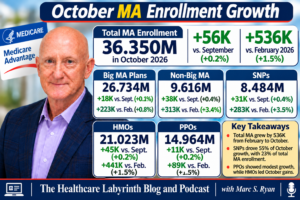
September To October 2026 Medicare Advantage Enrollment

October enrollment ticks up as 2027 open enrollment opens, with SNPs a majority of the increase In a February 16 blog, I detailed the growth in Medicare Advantage (MA) from February 2025 to February 2026 after a delay from the Centers for Medicare and Medicaid Services (CMS) in posting the annual data. As I noted, the January enrollment statistics in both years seemed off so many analysts are comparing February to February each year. Each month since then, I have updated with monthly growth numbers. Now, we have October results. For those who may have missed earlier blogs, I am refreshing on some of the annual results as we go into another open enrollment season. The annual statistics show some of the financial struggles the industry continues to have. Annual growth is way down compared with prior years in the 2020s due to major geographic contractions as well as plan

Read More »

The Healthcare Agenda After the Democratic Wave Wiped Out Republicans

What will come of healthcare as the Democrats take over both houses of Congress In my November 5 blog, I reviewed what I got right and wrong about the midterms. I correctly predicted Democrats would capture both houses of Congress but underestimated the political tsunami. Affordability, including healthcare, helped dismantle the GOP’s majority. As promised, let’s examine what comes next. Democrats could finish with 54 to 56 Senate seats and roughly 260 House seats. That is an incredible achievement not seen for some time. As a side note, I would say that polls again were wrong in 2024 and 2026. It missed both waves. But the prediction markets seemed to have it closer. Polymarket and Kalshi both had very high probabilities of the Democrats’ takeover of both houses. Could prediction markets now be a better way to understand voter and public sentiment? The markets appeared to be more predictive of

Read More »

Midterm Results: How Right I Was and How Wrong I Was

The Democrats’ political tsunami has a message for both parties On November 2, just one day before the midterm elections, I published my final forecast: Democrats would take back both chambers of Congress. I was right. But how wrong I was, too! Even I underestimated just how big the Democratic victory would be. Let’s start with what I got right I predicted a huge Democratic victory in the House. In my last forecast, I had Democrats winning somewhere between 235 and 245 seats. While the final numbers will end up higher than my high-end forecast, I clearly predicted a huge margin for Democrats in the lower chamber. As of Thursday, November 5, the latest results show Democrats with approximately 253 seats to Republicans’ 155, with 27 races still undecided. That is already an almost 40-seat net gain, and there is still room for the Democratic margin to grow. I also

Read More »

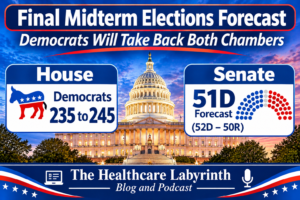
My Final Midterm Election Forecast: Democrats Will Take Back Both Chambers

The polls now point to Democrats easily taking the House and more likely than not to take the Senate Back on October 8, I told you that Democrats would easily take the House and their margins there were growing. However, I still said that the Senate was 50-50, with the GOP likely to have 50 or 51 seats and control the chamber because the White House is Republican. Now, we are here for the last update for the midterms. And the math looks increasingly daunting for the GOP perhaps to keep any chamber. Coming out of the summer political doldrums, the Democrats have maintained the edge as affordability, the war, and energy costs are top of mind for voters. The GOP at a disadvantage As I have said in past blogs on the midterms, the GOP has a huge uphill battle to keep control of both chambers. I looked at

Read More »

Healthcare Affordability Will Deliver The GOP A Huge Setback In Midterms

The GOP fundamentally misread affordability issues, in particular on healthcare The midterms are Tuesday, November 3. I will offer my final House and Senate predictions Monday, the day before Americans finish voting. But following my earlier election forecast and debt blogs, I wanted to examine an issue that could help determine the outcome: healthcare affordability. Healthcare is playing an outsized role, both independently and within the broader affordability debate. The polling increasingly explains why Republicans should be worried. The polls tell a clear story United States of Care’s (USofC) People’s Health Care Survey finds that 76% of registered voters consider healthcare one of their top three voting issues. Fifty-six percent say healthcare is unaffordable, while 73% feel frustrated, overwhelmed, or helpless about costs. Only 42% of people with employer coverage report satisfaction with their insurance, compared with 66% of Medicare enrollees. Healthcare policy group KFF’s October polling reinforces the point.

Read More »

Cloudy Outlook: Comprehensive Stars Litigation Update

Updated 11/10/2026 for additional lawsuits. Just after the Centers for Medicare and Medicaid Services (CMS) issued Star Year (SY) 2027 results, we got some new lawsuits attacking the agency’s calculations, in part related to the favorable treatment obtained again by Clover Health. So, it was time for a comprehensive update on SY 2026 and SY 2027 litigation. I have tried to keep the updates short and cogent, but Stars is not that at all right now. Where we stand on litigation We have 12 total plans suing CMS for SY 2026 and/or SY 2027. A total of 15 lawsuits, not counting CMS’ appeal of Clover. We had four 2026 Stars measure lawsuits — Clover, Elevance, Scan, and Alignment. We now have 11 2027 Stars measure lawsuits — Alignment, Healthfirst, Centene, Scan, CVS’ Aetna, Elevance Health, Blue Cross Blue Shield of Rhode Island, Jefferson Health Plans, Verda Healthcare, Banner Health, and

Read More »

Long-Overdue Accountability for Medicare Advantage and PBMs

CMS is proposing reforms to address longstanding problems with Medicare Advantage and pharmacy benefit managers The Consolidated Appropriations Act of 2026 included several provisions that could meaningfully improve transparency and accountability in Medicare Advantage (MA) and Medicare Part D. The Centers for Medicare and Medicaid Services (CMS) has now proposed regulations to implement them. I support these changes. They address problems that have persisted for far too long, and they reinforce a principle I have argued repeatedly: healthcare organizations should be accountable for the value they deliver to members. MA must get Its networks right I have long supported MA. It offers millions of seniors coordinated care, additional benefits, and quality alternatives to traditional Medicare. But supporting MA does not mean ignoring its shortcomings. Provider directories and network accuracy have been problems for decades. Members choose plans based on whether their physicians, hospitals, and other providers participate. When that information

Read More »

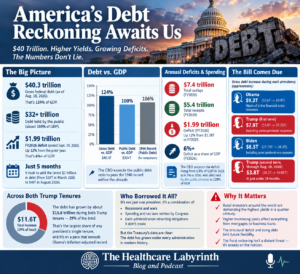
The Fiscal Labyrinth: America’s Debt Reckoning Awaits Us

While few are talking about it, America’s debt crisis is perhaps the most important issue out there now and for future generations. The United States has crossed $40 trillion in gross federal debt, bond investors around the world are demanding the highest yields in a quarter century, and the political class is behaving as if nothing is wrong. Too harsh? Read on and you will see why this is perhaps the most important issue facing voters this election cycle. I believe a fiscal reckoning is on the horizon. The warning signs are clear from a series of bond events we have just witnessed. A budget director’s vantage point. As a former state budget director and management secretary, I have spent a career reading budgets the way a physician reads a medical chart: looking past the headline number to the underlying vital signs. A state, unlike Washington, D.C, cannot print money,

Read More »

When Drug-Price Reform Becomes a Medicare Advantage Headwind

Will MA have yet another rate headache with the GUARD and GLOBE models? I have been a major proponent of President Donald Trump’s GUARD and GLOBE drug pricing models for Medicare Part D. More than any president, Trump has really made great traction on drug pricing. Of course, critics poke holes in the myriad of reforms. I have some questions too, such as why brand drug makers agreeing to other drug price deals with Trump should be exempt from these MFN programs. But on balance, the movement is important to finally get our arms around the ongoing surge in drug prices. Yes, I admit the Biden administration took steps with the Medicare drug price negotiations. But it is ironic that a Republican administration now has done more than any administration to pursue real reform. Today’s blog, though, covers a concern Medicare Advantage (MA) plans should have about how GUARD and

Read More »

Available Now

$30.00