
The fallout from the Clover Health Medicare Advantage (MA) Star Ratings decision has become considerably more complicated.
What started as one health plan challenging its 2026 Star Rating has now developed into a series of lawsuits that could force the Centers for Medicare & Medicaid Services (CMS) to confront not one, but several competing approaches to calculating Star Ratings. And with Star Year (SY) 2027 ratings approaching, CMS may soon have to decide whether—and how—to extend any of those approaches across MA contracts.
The important point is that the plans are not all asking for the same thing.
That is where this story gets interesting and potentially very messy. I described this in an earlier blog as the Balkanization of Star measurement.
Clover created the opening
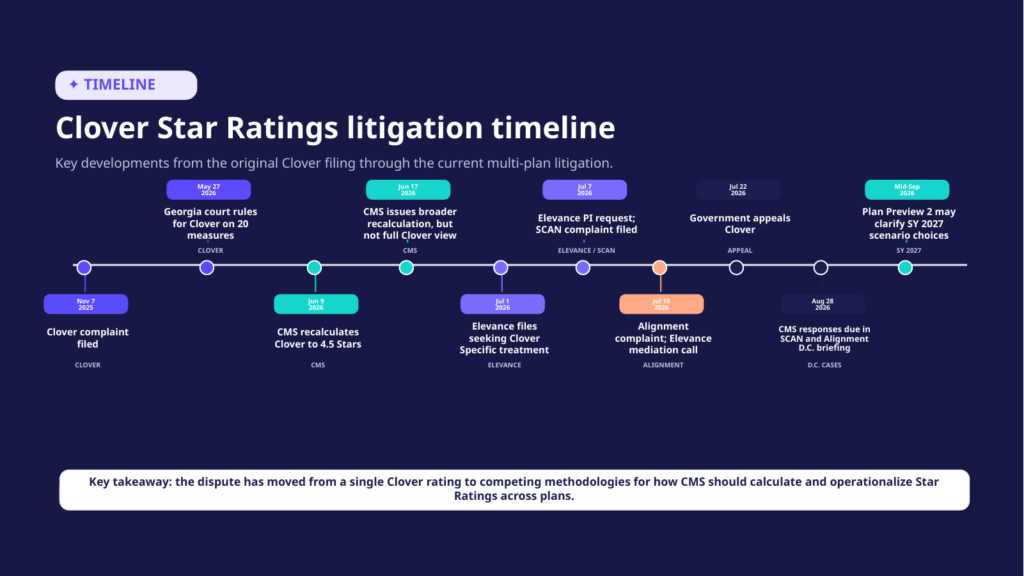
Clover filed its lawsuit in November 2025 after its largest MA contract received a 3.5 Star rating for 2026. On May 27, 2026, Judge Lisa Godbey Wood of the U.S. District Court for the Southern District of Georgia ruled partially in Clover’s favor. The court identified problems with 20 Star Ratings measures.
Ten measures were found to be problematic because of the statutory restrictions governing the data CMS may use in Star measurement. Another ten were found deficient because CMS had not promulgated their specifications “by regulation” as required by the Medicare statute. In essence, CMS has both a regulatory and statutory problem with Star measures right now.
The court set Clover’s rating aside and ordered CMS to recalculate it. CMS did so quickly. Clover’s affected contract ultimately received a 4.5 Star rating and the opportunity to submit a revised bid. CMS used the measures Clover asked for, setting aside 20 measures – I call this the Clover Specific scenario. This is what the judge seemingly asked CMS to do.
CMS appealed that decision on July 21 to the Eleventh Circuit, so the underlying legal questions remain very much alive. In the meantime, Clover nets about $120 million in additional Star bonuses.
But the immediate consequence was more important for the industry: Clover suddenly had a different measuring stick or Clover Specific. It is the measure set and recalculation methodology CMS ultimately used specifically for Clover after the court’s judgment.
CMS then faced the obvious question: What should it do with everybody else?
On June 17, CMS voluntarily recalculated Quality Bonus Payment ratings for certain other Medicare Advantage contracts. But CMS did not simply apply the full Clover result industrywide.
Instead, it created what I call the CMS Recalculation scenario.
CMS implemented only part of the court’s reasoning, recalculated affected contracts, and protected plans through a “better of” approach so that a plan did not lose its existing rating because of the recalculation. That was perhaps a defensible administrative compromise, although CMS ignored part of the judge’s ruling (perhaps to preserve its appeal rationale).
But it created another problem.
We now effectively had three possible views of SY 2026: the Original Rating, the CMS Recalculation, and Clover Specific.
And that is exactly what triggered the next wave of litigation.
Elevance wants Clover Specific
Elevance filed suit July 1 in the same Georgia court—and before the same judge—that decided Clover.
Its argument is fundamentally about consistency.
Elevance says that if CMS concluded Clover should be calculated using a particular set of measures following the court’s ruling, similarly situated Elevance contracts should receive the same treatment. Elevance has emphasized that Star Ratings operate in important respects like grading on a curve: plans are evaluated using common methodologies and relative distributions. Different measuring sticks therefore raise obvious questions about comparability.
Elevance says applying the Clover methodology to its affected contracts could mean approximately $115 million in additional 2027 Quality Bonus Payments and rebates.
CMS has pushed back hard.
It argues that Clover is different for a simple reason: Clover went to court and obtained a judgment. A party-specific judicial order does not automatically become an industrywide injunction.
There is also a fascinating technical dispute over what “the Clover methodology” actually means. Elevance says CMS should return to the October 2025 administrative record, eliminate the measures the judge found unlawful and hold the other published inputs constant. CMS argues that removing measures can require recalculating systemwide components such as improvement-measure cut points, reward factors and the Categorical Adjustment Index. It asks whether removing an unlawful measure means simply taking that measure out—or reconstructing the interconnected Star Ratings system as though the measure had never existed.
Elevance has several strengths and had requested an expedited decision. The same judge already decided the underlying Clover issues, and CMS faces the awkward question of why materially similar plans should be evaluated differently. CMS appears to be banking on several timing and remedy defenses, including Elevance’s delay in challenging its original ratings and the complexities of reopening bids.
My directional assessment remains that Elevance has better-than-even odds of ultimately obtaining meaningful relief if the case returns to a merits-based decision, but with significant uncertainty around timing and the exact remedy. Elevance has a sympathetic judge already familiar with the subject matter. These are better odds than what the Stars suit decisions would merit. Despite some high-profile plan wins, most decisions the past several years have gone the way of CMS.
There is now another wrinkle. Georgetown’s Health Care Litigation Tracker currently lists the Elevance matter as stayed. I see no judge’s order has yet been posted, but it now may be stayed due to the appeal in the Clover case filed by CMS. Staying cases when related ones are on appeal is common. That makes the immediate timetable less predictable than it appeared when briefing accelerated toward the planned August preliminary-injunction proceedings.
SCAN and Alignment are asking for something different
SCAN, which filed July 7, and Alignment Healthcare, which filed July 10, are not asking CMS simply to give them the Clover Specific calculation. They are pursuing what I call the Clover Strict scenario. Their focus is on the second half of Judge Wood’s Clover decision: the 10 measures whose specifications the court concluded were not properly promulgated “by regulation.”
To understand this, let’s go back to the Clover decision. Despite ordering the recalculation seemingly based on throwing out the 20 measures Clover challenged, other pieces of the decision determined that other measures outside of CAHPS, HOS, and HEDIS are actually disallowed in the program. As I noted, when CMS adopted its better of CMS Recalculation and Original Ratings, it decided to pick and choose what it implemented from the judge’s ruling. It removed all measures but CAHPS, HOS, and HEDIS, but kept in the ten CAHPS and HOS measures that the judge said have regulatory deficiencies.
SCAN and Alignment contend that CMS cannot use sub-regulatory Technical Notes to establish specifications that ultimately determine statutory MA payments when Congress required substantive Medicare standards of this kind to go through formal rulemaking. This thus leads to the strict interpretation scenario of the Clover decision, where CMS essentially ceded the statutory argument but ignored the regulatory deficiency finding.
SCAN says removing the ten measures would move two contracts from 4.0 to 4.5 Stars and generate approximately $125 million in additional 2027 rebate funding. Alignment says its affected contracts would similarly move from 4.0 to 4.5 Stars, worth approximately another $50 million.
Both cases are pending in the U.S. District Court for the District of Columbia, and both are moving on expedited tracks, unless they are also stayed due to the CMS appeal of the Clover case. The Georgetown tracker currently lists CMS’ responses to their summary-judgment motions as due August 28.
Their path is somewhat harder than Elevance’s because the D.C. court is not bound by Judge Wood’s Clover ruling. But the plaintiffs have a serious argument: the exact statutory rulemaking theory they are advancing has already persuaded one federal judge, and Star Ratings indisputably have major payment and benefit consequences.
Like Elevance, I would put both cases at better-than-even odds. But again, timing and the exact remedy are very much in play. Judges notoriously are reluctant to direct sweeping remedies, even in the post-Chevron world.
But CMS now has a genuine scenario problem
This is where the litigation becomes an operational problem for CMS rather than simply a legal problem.
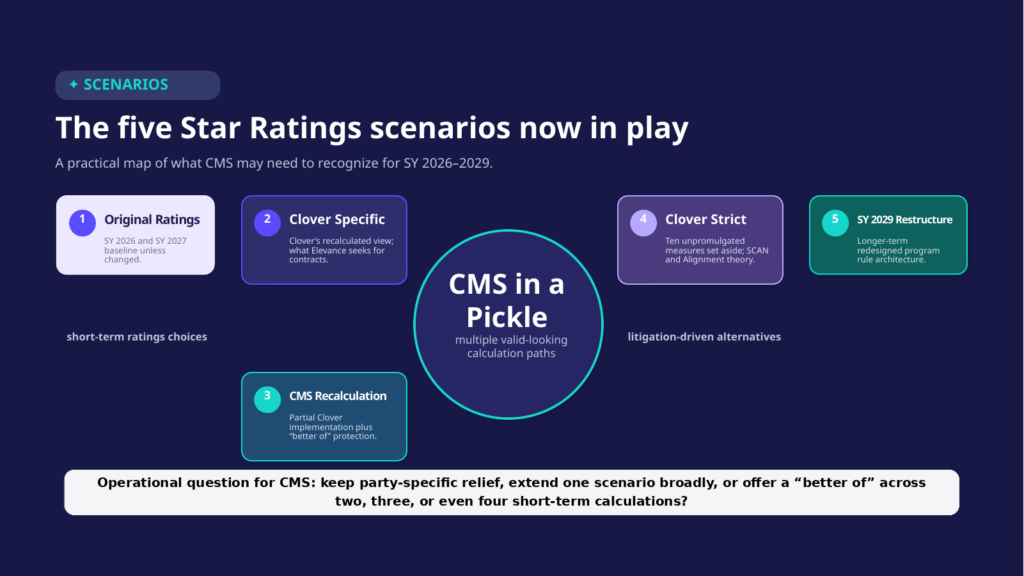
I have now identified five scenarios for thinking about Stars:
- Original Ratings — the ratings CMS initially calculated.
- Clover Specific — the calculation Clover received and Elevance is pursuing.
- CMS Recalculation — CMS’ legally dubious approach, including its existing “better of” protection.
- Clover Strict — the 10-measure set-aside approach sought by SCAN and Alignment.
- SY 2029 Restructure — the longer-term redesign of the Star Ratings framework CMS put into place via regulation, although it likely has statutory deficiencies that Congress will need to solve as well as regulatory deficiencies CMS will need to return to.
For SY 2026, CMS has already had to live with the first three.
If Elevance wins, Clover Specific could cease to look like a one-plan anomaly.
If SCAN or Alignment wins, CMS could suddenly have a fourth relevant calculation—Clover Strict.
That is the pickle.
Does CMS continue awarding relief only to successful litigants? Does it extend one of these methodologies industrywide? Does it give plans the “better of” two scenarios, three scenarios—or conceivably four?
A four-way better-of exercise sounds administratively extreme. But so does maintaining different legally significant rating methodologies for plans competing inside the same program.
And then there is SY 2027
The bigger question for most plans is no longer merely what CMS does with SY 2026. It is what these lawsuits mean for SY 2027.
My suspicion remains that Plan Preview 2, expected around mid-September, is the point at which the picture may become substantially clearer. Plan Preview 1 is primarily about reviewing reported data and identifying discrepancies. No announcement about what scenarios, if any, will be included in ratings calculations for SY 2027. By Plan Preview 2, CMS will be under much greater pressure to tell plans what methodology will actually govern the next rating cycle. There is industry chatter that CMS guidance could come sooner. So, it would not surprise me if CMS does announce something soon before Plan Preview 2.
The litigation is now operating on three fronts. Elevance is before the Georgia court that decided Clover, while SCAN and Alignment are proceeding in D.C. Meanwhile, Clover itself is on appeal in the Eleventh Circuit by CMS.
CMS therefore must make operational decisions while multiple judges—and eventually appellate courts—are still considering the legal foundation of the system.
Plans’ dilemma
Clover exposed legal vulnerabilities in the Star Ratings methodology. Elevance asks whether CMS can give one litigant a different measuring stick. SCAN and Alignment ask whether ten measures can lawfully remain in the program without formal rulemaking. The Clover judge actually opined that no measures but HEDIS, CAHPS, and HOS are statutorily allowed.
For plans, the key question over the next several weeks is therefore not simply “Who wins the lawsuits?” It is — which of these Star Ratings scenarios will CMS decide it must recognize—and will plans receive the better result when more than one applies?
By Plan Preview 2, we may finally begin to get that answer.
Since revenue is directly tied to Stars outcomes, plans will need to consider not just what scenarios they benefit from, but a regulatory and legal strategy that may be needed to ultimately get the award that is best for them.
#stars #medicareadvantage #partd #quality #cms
— Marc S. Ryan