physicians

Clover Wins Lawsuit And Could Mean More Change For Medicare Advantage Stars Program

Although Stars is not going anywhere, the combination of SY 2029 regulatory changes and the lawsuit mean more challenging times for Medicare Advantage plans. NOTE: This blog is published in collaboration with Lilac Software, Inc. For more information on Lilac’s Stars Analytics Platform, see the end of this blog. In a stunning decision, a federal judge in Georgia ruled in favor of Clover Health in its lawsuit challenging its 2026 Star Ratings. What’s more the judge seemingly has thrown out 20 measures in the program. The judge ordered just Cover’s 2026 ratings, impacting 2027 payments, to be recalculated. But it is hard to see how this could not impact all contracts if the ruling is upheld. Indeed, the Clover decision makes the 2024 Tukey cases and impacts look minor. I do not believe Stars is going anywhere. It is too important to value-based care overall. But the decision does throw

Read More »

Digging Into My Modest Election-Year Proposal For Healthcare Reform: Details Part 1 — The Importance Of Price Reform

NOTE: With the midterms coming and a bit of a lull in healthcare news, over the next few weeks I will be re-publishing my 2024 election year series on healthcare reform (with a few updates). It remains as relevant for midterms 2026 as it was two years ago. This blog is one in a four-part series that digs into my modest proposal for healthcare reform. See the introductory blog here to review my proposal more broadly: https://www.healthcarelabyrinth.com/a-modest-election-year-proposal-for-healthcare-reform-2/ . Much of my proposal is taken from my book, The Healthcare Labyrinth, available at this site and through leading bookseller websites. It is available in print, ebook, and audiobook forms. The importance of price reform In my “A Modest Election-Year Proposal For Healthcare Reform” blog, I stressed that the cornerstones of reform are three key tenets – driving affordable universal access, reforming price, and pivoting to primary care and care management from our

Read More »

A Modest Election-Year Proposal For Healthcare Reform

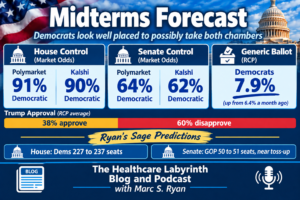
NOTE: With the midterms coming and a bit of a lull in healthcare news, over the next few weeks I will be re-publishing my 2024 election year series on healthcare reform (with a few updates). It remains as relevant for midterms 2026 as it was two years ago. In a recent blog, I told you that Democrats are heavily favored to win the House and that the Senate has become amazingly competitive. In part, this is because the GOP has failed to tackle affordability and the cost of healthcare is top of mind for many voters. More and more have seen their employer coverage costs skyrocket even as coverage became skimpier. Over 24M Exchange enrollees saw surges in premiums due to COVID subsidy enhancements expiring. Millions are expected to lose coverage in 2026. As most American grapple with healthcare affordability, there is little doubt in my mind that the time

Read More »

April to May 2026 Medicare Advantage Enrollment

May enrollment bounces back In a February 16 blog, I detailed the growth in Medicare Advantage (MA) from February 2025 to February 2026 after a delay from the Centers for Medicare and Medicaid Services (CMS) in posting the annual data. As I noted, the January enrollment statistics in both years seemed off, so many analysts are comparing February to February each year. On March 30, I updated my blog site with results for March 2026. On April 20, I updated my blog site with results for April 2026. Now, we have May results. For those who may have missed the earlier blogs, I am refreshing on some of the annual and early 2026 results. The annual statistics show some of the financial struggles the industry continues to have. Growth is way down compared with prior years in the 2020s due to major geographic contractions as well as plan benefit reductions

Read More »

2027 ACA Exchange Rule Signals Paradigm Shift

Even more innovation would be welcome Readers of this blog will know that I am on a bit of a transformation in terms of how I view coverage. I have always been a comprehensive coverage guy. I have backed reasonable subsidies as well as coverage that ensures people to access primary care and prevention upfront. But the problem is that coverage and benefit design in this country appear to be more broken than not. I recently have made the argument that coverage and strong benefits on paper do not mean people can truly access healthcare benefits with massive repercussions for people’s health and the nation’s quality statistics. I think this will continue to be true and almost certainly worsen if we do not reform price. And there is good reason to believe that even if we did reform price, looking at newer models to incentivize primary care and prevention should

Read More »

Health Plans’ Stocks Soar; So, Is All Well?

Health plans have plotted a comeback and so far it is working Q1 offered a cautiously encouraging picture for the U.S. health insurance sector. After a bruising couple of years marked by elevated utilization, Medicare Advantage (MA) margin compression, and policy disruption, most large plans are reporting improved financial performance. Stocks soared as a result. So, is plan financial health back? Well, not so fast. The positive financial performance is more a result of low expectations and plans are still, like Sisyphus, pushing a huge boulder up a hill. And given trends, it could very well come rolling back down. There was a literal financial meltdown at some plans beginning as early as 2024. Some of this was caused by external factors. But a great deal of it, too, was due to a lack of discipline by plans in multiple areas – finance, quality, and operations. It was an embarrassment

Read More »

The Big Bang: The Part D Instability Factor

Market forces and politicians are undermining Part D For the past few years, seniors may have noticed that their Part D retail drug benefits have gotten skimpier even as cost-sharing has been capped for some. Overall, most recipients are seeing more costs not less. This relates in part to a move by the former Biden administration supposedly to lighten the load. When politically motivated administration officials and lawmakers get involved, the public and taxpayers usually get the shaft. The Medicare Part D program has always been something of a paradox: a privately administered benefit built on deliberately thin margins, sustained not by profitability alone but by a carefully engineered system of federal subsidies and risk-sharing. Created under the Medicare Prescription Drug, Improvement, and Modernization Act (MMA) in 2003, Part D was designed to attract plan participation while protecting both beneficiaries and insurers from extreme financial volatility. For much of its

Read More »

Prior Authorization Restrictions Continue To Take Hold

Despite voluntary actions, CMS continues with PA reforms The Centers for Medicare and Medicaid Services (CMS) has been active in reining in prior authorization at health plans and the reforms continue. In 2024, CMS proposed and finalized a rule that put major restrictions on the ability of Medicare Advantage (MA) plans to use PA for inpatient procedures and post-discharge care. The rule mandates that providers have the call as to whether a patient needs inpatient admission and what after-care is required. Upon returning to office, the Trump administration called health plans to the table to “volunteer” to make PA reforms across business lines or they would face action by the federal government. So, they were in essence “voluntold” to make the reforms, which they obediently did. In a major announcement shortly after, a group health plans and the two main lobbies (representing 75% to 80% of covered Americans) said they

Read More »

Hospital Price Reform May Be Mounting

A stunner on Capitol Hill shows payment changes could be coming Of all the segments of the healthcare system out there, hospitals over the years have weathered the rate and payment reforms the best. Health plans had the minimum medical loss ratio (MLR) reforms implemented, which has constrained overall margins for most plans, save for how some very large conglomerates are able to move regulated money to unregulated areas of sister companies. And for sure, the poor primary care physicians have seen their real pay over decades shrink dramatically. That has caused an existential crisis in America for primary care. While they have not always been happy, hospitals, however, have always been relatively insulated from political storms. After all, they have built a formidable bipartisan lobby that has kept most lawmakers sympathetic to hospitals’ positions. But could things be changing for hospitals? We are now seeing some high-profile calls for

Read More »

Trump Responds To Healthcare Affordability Crisis

An affordability czar comes too late for midterms, but could help plot a course There was a clear sign recently that the Trump administration is worried about the impact of the lack of healthcare affordability. It created a top-level healthcare position that will be a de facto affordability czar. Health and Human Services Secretary Robert F. Kennedy, Jr. has named Casey Mulligan as chief economist and chief regulatory officer of the agency. He’ll advise Kennedy and other agency leaders on affordability issues. Mulligan was on the Council of Economic Advisers during the first Trump administration and was most recently the U.S. Small Business Administration’s chief counsel for advocacy. That same week, healthcare policy group KFF issued a briefer on Americans’ views of healthcare. Just under half of U.S. adults say it is difficult to afford healthcare costs, and about three in ten say they or a family member in their

Read More »

Available Now

$30.00