sdoh

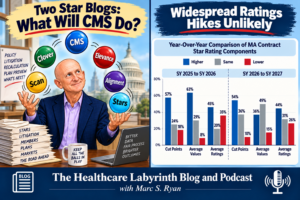
The Clover Fallout Continues: Elevance, SCAN, Alignment—and Now CMS’ Appeal

Strap in for the Clover Stars roller coaster ride. We are still violently looping around. Just when you thought the Clover Health Star Ratings saga could not get any more complicated, it has. In my August 17 blog on the fallout from the Clover decision, I laid out again what I call the growing “balkanization” of Medicare Advantage (MA) Star Ratings. We effectively have different potential rating scenarios depending on which interpretation of the Clover decision is applied. And different health plans are now in court seeking the calculation that benefits them the most. Since then, we have had three important developments. First, the SCAN Health Plan and Alignment Healthcare cases are moving forward in Washington, D.C. Second, a federal judge denied Elevance Health’s request for a preliminary injunction, but gave Elevance some very encouraging language on the merits. Third, the Centers for Medicare and Medicaid Services (CMS) has now

Read More »

My Latest Midterm Election Forecast

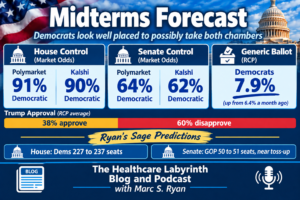
The House still looks very likely to flip to Democratic control, with the Senate still in limbo As the midterms approach, I always give you a fresh look at what could happen in terms of control of Congress. Back on June 8 I did my last forecast. I likely will do this again in late September and more frequently after that. As I have said, healthcare will be a big part of how votes are cast in November. Affordability overall is a top issue this election year and healthcare affordability dominates this issue in many ways. The GOP at a disadvantage As I have said in past blogs on the midterms, the GOP has a huge uphill battle to keep control of both chambers. I looked at every midterm election since 1934. No matter how popular a president might be, only on two occasions has the party in control of

Read More »

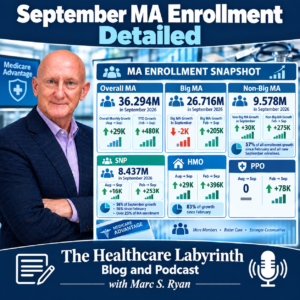
July to August 2026 Medicare Advantage Enrollment

August enrollment shows MA continues to grow, with SNPs a majority of the increase In a February 16 blog, I detailed the growth in Medicare Advantage (MA) from February 2025 to February 2026 after a delay from the Centers for Medicare and Medicaid Services (CMS) in posting the annual data. As I noted, the January enrollment statistics in both years seemed off so many analysts are comparing February to February each year. Each month since then, I have updated with monthly growth numbers. Now, we have August results. For those who may have missed earlier blogs, I am refreshing on some of the annual results. The annual statistics show some of the financial struggles the industry continues to have. Annual growth is way down compared with prior years in the 2020s due to major geographic contractions as well as plan benefit reductions by major MA players the past few years.

Read More »

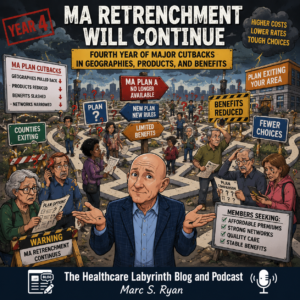
Medicare Advantage Retrenchment Is Not Over — 2027 Could Bring Another Tough Year

2027 will be four years running for cubacks in MA If Medicare Advantage plans thought 2027 would finally mark the end of the industry’s painful retrenchment, they may want to think again. The early signs point toward another year of significant market exits, benefit changes, network adjustments and efforts to control enrollment. And this isn’t exactly new. Medicare Advantage has essentially been going through a multi-year reset since 2024. Rising utilization, inadequate rate trends, the new risk adjustment model, other worries on risk adjustment recoupment, deteriorating Star ratings, and other regulatory changes hit an industry that had expanded aggressively during the preceding years. The result has been a painful process of getting the economics back in balance. 2027 looks increasingly like year four of the MA reset The problems really emerged in 2024, when medical utilization increased far beyond what some insurers had anticipated. Seniors returned for procedures and services

Read More »

ICHRAs Growing And Can Be Part Of The Healthcare Reform Solution

ICHRAs growing and respond to affordability issues Individual Coverage Health Reimbursement Arrangements (ICHRAs) are getting more attention. And they should. I think ICHRAs are an interesting option that can expand coverage and give employees more choice. But as with almost everything in healthcare, we should distinguish between changing who pays for healthcare and actually making healthcare more affordable. That is an important part of the healthcare debate. What is an ICHRA? An ICHRA, just rebranded as CHOICE Arrangements or Custom Health Option and Individual Care Expense, allows an employer to provide employees with a defined amount of tax-advantaged money that employees can use to purchase individual health insurance coverage rather than enrolling in a traditional employer-sponsored group plan. In some ways, it is the healthcare equivalent of the shift from defined-benefit pensions to defined-contribution retirement plans. The employer establishes its contribution, while the employee has more responsibility—and potentially more choice—in

Read More »

The Stars Fallout Gets Messier: Clover, Elevance, SCAN, Alignment—and the Scenarios CMS Now Has to Navigate

The fallout from the Clover Health Medicare Advantage (MA) Star Ratings decision has become considerably more complicated. What started as one health plan challenging its 2026 Star Rating has now developed into a series of lawsuits that could force the Centers for Medicare & Medicaid Services (CMS) to confront not one, but several competing approaches to calculating Star Ratings. And with Star Year (SY) 2027 ratings approaching, CMS may soon have to decide whether—and how—to extend any of those approaches across MA contracts. The important point is that the plans are not all asking for the same thing. That is where this story gets interesting and potentially very messy. I described this in an earlier blog as the Balkanization of Star measurement. Clover created the opening Clover filed its lawsuit in November 2025 after its largest MA contract received a 3.5 Star rating for 2026. On May 27, 2026, Judge

Read More »

The Exchange Enrollment Debate: The Truth Is Somewhere in the Middle

As usual in politics, the truth and best action is usually somewhere at the center There is a growing debate over the significant decline in Affordable Care Act (ACA) Exchange enrollment in 2026. The Trump administration and conservative policy organizations such as the Paragon Health Institute argue that much of the decline is good news: improper and fraudulent enrollees are finally being removed from the rolls. Others, including healthcare policy group KFF, point to a much different culprit — the expiration of the enhanced premium subsidies and the resulting affordability crisis. As I wrote recently in a Healthcare Labyrinth Newsfeed, I think the truth is somewhere in the middle. I am a strong supporter of affordable universal access to healthcare. It is one of the central tenets of my healthcare reform proposal. Premiums, deductibles, and other cost-sharing have to be reasonable if we expect people to maintain coverage, access healthcare,

Read More »

Medicare Advantage Audit And Enforcement: The Message From CMS Is Getting Clearer

A paradigm shift is looming in how CMS will oversee plans I have followed Medicare Advantage (MA) and Part D program audits for twenty years now. The evolution of the Centers for Medicare Medicaid Services’ (CMS) oversight has been amazing. The agency has moved from very lax standards and inconsistent enforcement to a carefully honed machine that has evolved standards (with Special Needs Plans (SNPs) protocols still evolving) and an exceeding level of professionalism. With that comes the annual program audit and enforcement reports. True, they have been published for years. But they have gone to the next level, with slick presentation emphasizing tips and best practices as to what plans need to know to drive performance on program audits. CMS’s latest Part C and Part D audit and enforcement report (from 2025 audits) sends a familiar — but increasingly important — message: compliance is no longer just about having

Read More »

Are Insurers Turning The Financial Corner? Yes, But There Is More Work To Be Done

The industry, which was a financial basket case a short time ago, is cautiously recovering. The second quarter earnings season has ended and it largely confirms what many investors had been hoping for: health insurers seem to be turning the financial corner. As I point out in my recent The Healthcare Labyrinth Healthcare Reform Series (blogs and podcasts), macro trends are terrible, but at least the short-term signals show recovery and stability. Yet, reaction in the markets and even from battered health plan executives (who mostly and terribly missed the mark for several years) seems to be continued caution and for good reason. It is hard to put the whole industry in one box. Each is unique, driven by any number of factors: (1) the health plan lines of business they are concentrated in and (2) how big their so-called healthcare operations services entities are. But generally, most of the

Read More »

PDP Premium Stabilization Fund No More

The Trump administration’s elimination of the demonstration in an election year is a mystery. During an election year, it is hard to understand exactly why the Trump administration decided to end the standalone Part D (PDP) premium stabilization demonstration pilot in 2027. In fact, this has been a program I have been entirely critical of. The reason for the program itself goes back to the Inflation Reduction Act (IRA) of 2022, where Democrats did their usual conspiring to pass misguided, political provisions that essentially upend the financial underpinnings of Medicare Part D. In that bill, numerous changes were included that would lower or cap cost-sharing for a subset of Part D beneficiaries. The problem – it was largely unfunded and forced greater costs and risks on Part D plans. Medicare Advantage (MA) plans offering Part D found ways to limit the destruction, although the IRA changes did contribute to the

Read More »

Available Now

$30.00