partc

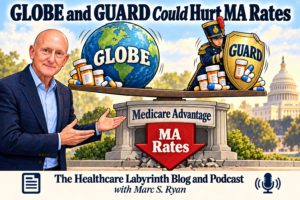
When Drug-Price Reform Becomes a Medicare Advantage Headwind

Will MA have yet another rate headache with the GUARD and GLOBE models? I have been a major proponent of President Donald Trump’s GUARD and GLOBE drug pricing models for Medicare Part D. More than any president, Trump has really made great traction on drug pricing. Of course, critics poke holes in the myriad of reforms. I have some questions too, such as why brand drug makers agreeing to other drug price deals with Trump should be exempt from these MFN programs. But on balance, the movement is important to finally get our arms around the ongoing surge in drug prices. Yes, I admit the Biden administration took steps with the Medicare drug price negotiations. But it is ironic that a Republican administration now has done more than any administration to pursue real reform. Today’s blog, though, covers a concern Medicare Advantage (MA) plans should have about how GUARD and
Read More »

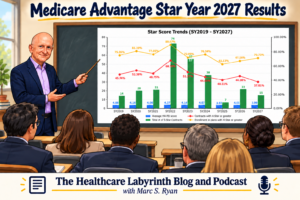
Medicare Advantage Star Year 2027 Results & Analysis: Some Plans Gain, But Many Decline – Another Year Of Challenging Results

Plans’ Star ratings stabilized a bit but challenges remain Thursday night saw the release of Star Year (SY) 2027 quality performance results for the Medicare Advantage industry, and the news was again not good. For all practical purposes, we are in the fifth year now of poor results coming out of the COVID pandemic and a peak in SY 2022. We did have some notable gainers, who recovered from years of Star doldrums. But other big players saw considerable declines. All things said, the industry was basically flat. The results add to the challenges plans have with declining risk adjustment revenue and rates that are not keeping up with utilization trends. A high-level barometer look I like to look at three figures the minute results are released. They tend to encapsulate the whole picture. The data throughout this blog compares SY 2027 results to the recalculated “better of” ratings announced

Read More »

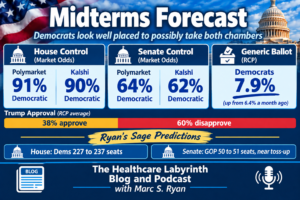
My Latest Midterm Election Forecast

Coming out of summer, Democrats look well placed to possibly take both chambers As the midterms approach, I always give you a fresh look at what could happen in terms of control of Congress. Back on August 31 I did my last forecast. A great deal has changed. I told you that summer election polling is notoriously unreliable. There is a lack of engagement during the summer months by voters. Such polls also usually hit registered voters instead of likely voters. And, history would show that summer polls appear to be biased toward Democrats, consistently overestimating support for the party. Polls begin to become more accurate post Labor Day as polling switches to likely voter concentration and voters become more engaged. The problem for Republicans, though, is that the latest polls appear to be saying the same thing they did prior to Labor Day. There is some evidence that GOP

Read More »

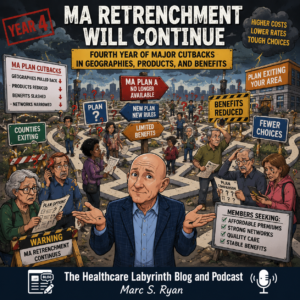
Part 2: Medicare Advantage Retrenchment Isn’t Over, and the 2027 CMS Files Prove It

The CMS headline is stability. The details say another tough year for members and plans. The Centers for Medicare and Medicaid Services (CMS) wants you to see Medicare Advantage (MA) in 2027 as a story of lower premiums and steady choice. In its Sept. 28 release, CMS projected that the weighted average monthly MA premium would fall from $14.37 to $12, a 16.5% drop, and that the average Part D premium inside MA drug plans would fall 38%, from $11.32 to $7. The industry tells a different story. Once you open the landscape and crosswalk files, I think the industry has it right. Stability on top, churn underneath The total number of MA plans barely moves, from 5,553 in 2026 to 5,532 in 2027. But that net number hides a lot of adds and cuts. The average beneficiary will have 28 MA-PD options, down from 32. MA-PD products will fall

Read More »

Following Up On My Priced Out Blog: Employers Plead For Relief

Smaller businesses could drop traditional coverage My September 7 blog on being priced out of healthcare ( https://www.healthcarelabyrinth.com/we-are-being-priced-out-of-healthcare-and-it-is-not-just-an-exchange-problem/ ) made the case that the affordability crisis went far beyond the Exchange subsidy debate. The bigger crisis we have is with employer coverage, where most Americans get their insurance. We also have a growing underinsured crisis as huge annual spending trends hit employers. Employers can only absorb so much. Eventually, the math catches up with everyone. Two recent developments make me even more concerned that we are approaching a genuine crisis. The first involves something most Americans have probably never heard of: the No Surprises Act’s federal arbitration process. The second is much easier to understand. Small and midsize employers are increasingly saying they may simply stop offering traditional health insurance. Those two developments may seem unrelated. They aren’t. They are two different manifestations of the same problem: Healthcare costs are

Read More »

Medicaid Quality Finally Gets a Stars-Like Wake-Up Call

CMS and 37 states are taking a hard look at Medicaid quality measurement. The opportunity is much bigger than simply eliminating paperwork. For years, Medicaid has had a quality problem. There has been no shortage of quality measures, reports, audits, core sets, HEDIS measures and external quality reviews. The problem is that all of that measurement has not necessarily translated into better health outcomes. Now, the Centers for Medicare and Medicaid Services (CMS) is trying to change that. On September 25, CMS announced its Investing in Health Outcomes initiative, with 37 states signing a voluntary Medicaid Quality Pledge. Those states represent approximately 56 million Medicaid and CHIP beneficiaries and about $701 billion in Medicaid spending during fiscal year 2024. The focus is long overdue. A CMS analysis of Medicaid managed care programs across 42 states found approximately 450 quality reporting requirements representing about 260 unique quality measures. Many focus on

Read More »

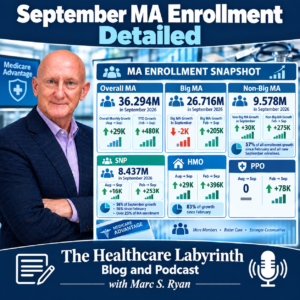
August to September 2026 Medicare Advantage Enrollment

September enrollment shows a dramatic slowing going into open enrollment, with SNPs a majority of the increase In a February 16 blog, I detailed the growth in Medicare Advantage (MA) from February 2025 to February 2026 after a delay from the Centers for Medicare and Medicaid Services (CMS) in posting the annual data. As I noted, the January enrollment statistics in both years seemed off so many analysts are comparing February to February each year. Each month since then, I have updated with monthly growth numbers. Now, we have September results. For those who may have missed earlier blogs, I am refreshing on some of the annual results. The annual statistics show some of the financial struggles the industry continues to have. Annual growth is way down compared with prior years in the 2020s due to major geographic contractions as well as plan benefit reductions by major MA players the

Read More »

Trump Publicly Holding Firm On AI Regulation, But Shows Concern Just The Same

Despite the bombast, growing concern at the White House on AI Last week, I wrote an in-depth blog here ( https://www.healthcarelabyrinth.com/ai-in-healthcare-innovate-but-with-guardrails/) urging a risk-based guardrail approach to AI regulation in light of Anthropic CEO Dario Amodei’s plea for an AI oversight game plan. At the time, President Donald Trump dismissed the calls, arguing the fears are overblown and we cannot lose the AI race to China. Trump continues to call the concerns a hoax and fabrication, but there is now reason to believe that the White House really does see apparent risks. On Saturday, with much fanfare, Trump announced that he is creating a new “AI Force” similar to the Space Force as well as appointing an AI czar “to regulate and grow artificial intelligence.” Although Trump does not acknowledge it, it is a bit of a flip-flop. The administration is known to be deeply divided on the potential risks

Read More »

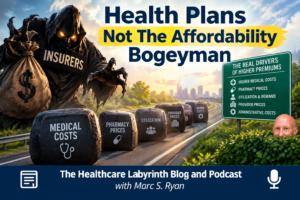
Fighting The Wrong War: Study Casts Aside Insurers As Affordability Bogeyman

Attacking health plans is fashionable, but calling them the bogeyman detracts from real reform In various cultures, a bogeyman is a shapeless monster used to scare children into good behavior. And there is little question that politicians – from Donald Trump to Democrats to Republicans — increasingly cast health plans as bogeymen in the debate over affordability. For Democrats, health plans have always been the evildoer. Democrats and other critics argue that insurers are earning enormous profits, wasting huge amounts on administration, and essentially ripping off consumers. But Republicans increasingly talk of health plans as responsible for the affordability crisis as well, frankly because they have done little to remedy the problem. Indeed, just as insurers were registering terrible margin numbers, President Trump repeatedly criticized insurers, saying they are making “billions and billions of dollars.” He argued that government healthcare money should go directly to individuals rather than insurers. A

Read More »

AI in Healthcare: Innovate, But With Guardrails

AI is here to say, but Dario Amodei’s admonition needs to be taken seriously. The debate over artificial intelligence just took another major turn. Anthropic CEO Dario Amodei, one of the people at the center of the AI revolution and one of its most thoughtful leaders, has issued another major warning about where AI could be heading. His message is not that we should abandon AI. Amodei has been outspoken about AI’s extraordinary potential to accelerate science, medicine, and economic growth. His concern is that capabilities may be advancing faster than our ability to understand and control the risks. In an essay, he said that, unless development slows and safeguards are put in place, rogue bots could take over the web in a few short months or bad actors could seize control of AI tools. His proposed reforms include having outside evalulators gain access to each froniter lab to ensure

Read More »

Available Now

$30.00