privateaffordableuniversalaccess

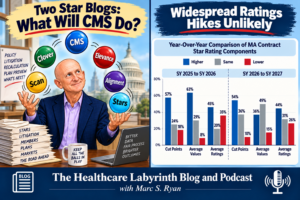
CMS Likely To Remake Star Ratings!

NOTE: This blog is co-published with Lilac Software. See the end of the blog for more information on Lilac’s Stars platform and agentic AI solutions. As low as Stars are right now, reaching higher in the future could be tougher A bit of a bombshell from Health Payer Specialist (link at the end of the blog) — well, yes and no. Officials at the Centers for Medicare and Medicaid Services (CMS) told the publication that changes likely are coming to the Medicare Advantage (MA) and Part D Star rating program. And this could make Star achievement even more difficult in a current environment where ratings are already in the doldrums. As I have said in the past, CMS and the White House have prominent conservative policy advisors, including from Brian Blase’s Paragon Health Institute. The think tank holds great sway in both the Trump administration and Congress. I have noted

Read More »

Will New Study Ignite Vertical Integration Scrutiny

UnitedHealthcare study may mean Congress takes up vertical integration reform A recent study published by Health Affairs about what UnitedHealthcare pays its sister providers compared with other network providers could ignite renewed scrutiny of vertical integration. It could also lead to a fresh look at what some call the gaming of the minimum medical loss ratio (MLR) mandate that touches virtually all insurance product types out there except self-insured employer coverage. The study finds that UnitedHealthcare pays its owned providers at sister company Optum 17% more than those it does not own. And if United controls 25% or more of a market, that percentage increases to 61%. Again, researchers said the results suggest the company may be sidestepping government rules regarding calculation of medical expenses against premiums. If those rules are not met, rebates need to be sent to the government, employers, or individuals depending on the type of coverage.

Read More »

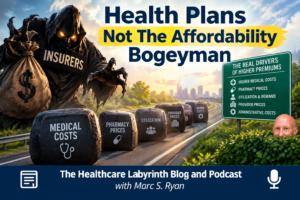
Recap Of Big Plan Q3 Financial News — MLRs Big Concern

Huge utilization and medical expense still a factor in insurer recovery Given the fiscal crisis happening in the health plan industry, I thought a quick blog summarizing Q3 2025 financial reports made sense. As well, a few more updates on Medicare Advantage (MA) contraction. One of my biggest observations is that medical loss ratios (MLRs), the way health plans measure the percentage of medical costs against premiums, remains at record levels. This appears to be across all lines of business – government programs and commercial/employer coverage. When MLRs are at 90 or well into the 90s (with the exception of commercial-only Cigna), you know things are upside down financially. And while plans continue to recover financially, there is little sign that high utilization, inflation, and costs will temper anytime soon. Further, developments in Medicaid and Exchanges as well as to some degree in MA could further complicate the medical cost

Read More »

Like Big Pharma Drug Price Concessions, Don’t Get Too Excited About PBMs Saying Rebates Going Away

Express Scripts’ announcement about drug rebates is a step forward, but not earth-shattering change In an October 9, 2025 blog, I applauded President Donald Trump’s efforts to redefine drug price in America. At the same time, I questioned whether some of the deals he has announced with brand drug manufacturers (aka Big Pharma) were truly game changers for drug price in America. I urged the president not to settle for these deals but to continue to push forward on true price reform. Along comes Cigna’s Express Scripts’ announcement that it would begin the process of migrating in part from the current gross price and rebate model to net drug pricing. This upends both its brand drug contracts with drug makers but also with insurers and employer groups. In part the announcement was precipitated by the Trump administration’s own demands that pharmacy benefits managers (PBMs) like Express Scripts abandon the rebate

Read More »

Peterson-KFF Health System Tracker Reports On Poor Healthcare Quality

It is not just about high costs in America for healthcare, it is about quality too Back on September 17, I did a quick blog on the Peterson-KFF Health System Tracker Chart Collection comparing U.S. healthcare prices and utilization against those in other developed nations. I like these periodic looks at prices and utilization throughout the developed world because it reveals at least one of the biggest reasons our healthcare system is in crisis or at least tumbling toward it – the highest prices in the developed world. A few key Peterson-KFF  findings as I related in the blog, which can be found here ( https://www.healthcarelabyrinth.com/u-s-healthcare-prices-compared-with-other-developed-nations/ ): Now, Peterson-KFF has released a new analysis and charts related to how America compares to the rest of the developed world in terms of quality outcomes and healthcare system performance. This is a bit like what The Commonwealth Fund does every three years

Read More »

Say It Isn’t So! Trump May Come Back On Affordable Care Act Replacement

The bad Exchange replacement nightmare keeps coming back Say it isn’t so. More talk of an ACA replacement? Just as 2026 midterm fundraising is heating up, Centers for Medicare and Medicaid Services (CMS) Administrator Dr. Mehmet Oz dropped a bombshell recently when he told NBC News that President Donald Trump may have a plan to overhaul and replace the Affordable Care Act (ACA). I emphasize “may.” Dr. Oz referred to the potential hidden plan as he was declaring his opposition to extending the current enhanced Exchange premium subsidies due to expire at the end of this year. “I fully believe the president has a plan,” Oz said. “We’ve been talking about it quite a lot.” He added there is a “full plan,” but Democrats are “hold[ing] the entire country hostage by shutting the government down … the folks who would help this system evolve into a mature model aren’t at

Read More »

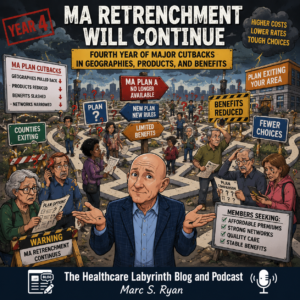
2026 Medicare Advantage Contraction Counter: Installment 3

More news on the contraction in MA due to the ongoing financial woes On October 6, I ran my second installment on 2026 Medicare Advantage (MA) contraction. As more information becomes public, we have learned a bit more on the scope and depth of MA and standalone Part D (PDP) plans’ pullback in benefits, products, and footprints. So, a quick update on some new findings. How many MA members will be forced to change plans during open enrollment? Deft Research says up to 5% of current MA members, or about 1.8 million people, will need to change plans because their plan was terminated. As I suspected, the impact of the contraction would again be high. Up to 2 million had to do so in 2025. So 2026, is just short of 2025. This represents two years in a row of major displacement for enrollees. Regional players filling the void? While

Read More »

Could An Exchange Subsidy Compromise Be In The Works?

Moderates on both sides of the aisle are quietly talking about ways to keep the ehancements at least for some time Despite what appears to be a government shutdown hurtling forward with little end in sight, a number of articles suggest that a compromise could be in the making to extend the enhanced premium subsidies in the Exchanges. Now, nothing is by any means certain for several reasons, but progress here or a deal itself could potentially be a basis for passing a bill to reopen government. Let’s give you some background and dive into the players, politics, and possibilities. The types of subsidies As part of the Affordable Care Act (ACA) of 2010, the state and federal Exchanges were set up to offer subsidized and unsubsidized coverage in the newly formed Marketplaces for those without consistent access to healthcare or who may need temporary access. For lower-income and some

Read More »

The Skinny On The Risk Adjustment Data Validation Decision

Plans may be delighted with the recent court ruling striking the RADV rule, but they should not cheer for too long. A federal court has vacated the 2023 Medicare Advantage (MA) Risk Adjustment Data Validation (RADV) audit rule finalized during the Biden years. The court nullified the entire rule not just portions of it. The decision was not unexpected. The Biden administration included so many far-fetched and indefensible provisions. At the same time, it is a bit of a shocker as it throws the Trump administration’s plans for a 100% RADV audit commitment into great flux. That certainly raises uncertainty for plans. Background After years of operating RADV audits through both the Centers for Medicare and Medicaid Services (CMS) and the Health and Human Services’ (HHS) Office of Inspector General (OIG) without rule-making authority, the Biden administration finally proposed a RADV rule under which recoupments in the MA risk adjustment

Read More »

Medicare Advantage Star Year 2026 Results & Analysis – Still Challenged but Stabilizing

(NOTE: This blog was co-published with Lilac Software. Learn more at https://lilacsoftware.com ) Plans’ Star rating stabilized a bit but challenges remain Last year at this time, the Medicare Advantage (MA) Star news for Star Year (SY) 2025 was a third drop in a row in Star performance from the peak in SY 2022. Here we are one year later and the picture is mixed. The three-year downturn in Star ratings appears to have ended, but SY 2026 was relatively flat to SY 2025. There has been little progress overall. While we see some signs of stability, it is fair to say that MA Star performance is still in the doldrums and the industry continues to have some of the lowest ratings ever. One key fact showing continued challenges for plans with Stars Star ratings overall remain at very low levels. Of the 481 MA contracts rated in both SY

Read More »

Available Now

$30.00