republicans

Logo

November 17, 2026

ACOs Register Higher Savings in 2025 Accountable care organizations (ACOs) in the Medicare Shared Savings Program (MSSP) had another record savings year in 2025. The 472 ACOs in MSSP generated $7.4 billion in gross savings in 2025. Participating organizations earned $4.9 billion in performance bonus payments, with Medicare saving $2.5 billion. The Medicare savings is up from $2.4 million in 2024, $2.1 billion in 2023, and $1.8 billion in 2022. In 2025, 80% of participating ACOs earned shared savings compared with 75% the year before. Of the participating organizations, 13 owed Medicare, with shared losses totaling $23 million, CMS said. #acos #medicare #vbc https://www.modernhealthcare.com/politics-regulation/mh-medicare-shared-savings-program-aco-2025 Hospital Margins Drop Hospital headwinds, including payer mix and rising costs, caused operating margins to drop, with healthcare advisory firm Kaufman Hall reporting a “historically large portion” of the nation’s hospitals running on negative or near-zero operating margins.  Kaufman’s monthly report says calendar year-to-date operating margins

Read More »
Logo

November 16, 2026

Calling All MA Plans: Three New Stars Lawsuits We are officially counting on our fingers and toes now! Three new Medicare Advantage (MA) Stars lawsuits. Currently, we have 18 lawsuits and 15 distinct plans which have sued the Centers for Medicare and Medicaid Services (CMS) over either their Star Year (SY) 2026 or 2027 ratings. Four for 2026 and 14 for 2027. Molina Healthcare sued CMS over its 2027 MA Star Ratings on Nov. 13 in D.C. federal district court, alleging improper data use cost the insurer $140 million in bonus payments. Molina cites CMS’ decision to use a favorable method to calculate Clover Health’s 2026 and 2027 scores. The company wants the court to declare it unlawfully included 14 measures when calculating its ratings. UPMC Health Plan filed its suit in the same court on Nov. 13 as well over 2027 ratings. It challenges 19 measures. UPMC alleges Administrative

Read More »

Why CVS Is Splitting Up, And Why Vertical Integration Survives

The announcement of the CVS breakup is not quite a breakup at all On November 4, CVS Health announced that it will divide itself into two publicly traded companies by the first half of 2028. The headline reads as a reversal of two decades of vertical integration strategy, a walk back from the 2007 Caremark deal and the 2018 Aetna acquisition. Shareholders certainly read it that way, and the stock fell roughly 10 percent on the news. But if you dig into the announcement itself, the headlines are actually a bit misleading. CVS is not abandoning vertical integration by any means. In fact, the proposal reinforces it. CVS actually is shedding the part of the integrated model that never fit quite well — the front-of-store retail pharmacy. It is keeping the part where the real economics of vertical integration success live — the insurer, the pharmacy benefit manager (PBM), specialty

Read More »
Logo

November 13, 2026

Medicaid Work Requirements On Hold For Six Months As states struggle to implement a new Medicaid policy so quickly and fears of millions losing coverage, the Trump administration is giving states an optional 6-month grace period for enforcing new work requirements due on Jan. 1. The Centers for Medicare & Medicaid Services (CMS) announced the move Friday, which runs through June 30, 2027. It says this gives states a transition period to further modernize systems, improve processes, and streamline the applicant and beneficiary experience. Studies estimate that between 5 million and 10 million people could lose coverage, most due to bureaucratic snafus or a lack of paperwork awareness — not because they are not working or do not qualify for an exemption. States that implement the hold harmless period will assess whether individuals meet the work requirement or are excluded from it, but they will not deny applications or disenroll

Read More »
Logo

November 12, 2026

Could States Further Cut Back Medicaid? A new Health Affairs Forefront blog reports that nearly two-thirds of respondents in a Cornell Health Policy Insight Panel survey said the One Big Beautiful Bill Act (OBBBA) could cause states to scale back Medicaid expansions. A majority said the law’s limits on state directed payments could reduce access to care. The OBBBA could be a triple whammy – reduced enrollment for work requirements, major cutbacks in eligibility and benefits due to reduced state Medicaid match from provider taxes, and less support for providers via state directed payments. #medicaid #obbba #coverage https://www.healthaffairs.org/content/forefront/experts-states-could-curtail-aca-medicaid-expansions-response-hr-1 No Surprises Act Cripples Employers Researchers at the Employee Benefit Research Institute find that the No Surprises Act’s independent dispute resolution (IDR) process cost employer plans $8.39 billion in 2025. Additional costs equal about 63 cents per $100 spent by employer-based insurance plans. The total includes $4.73 billion in costs incurred in

Read More »

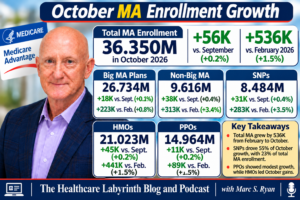
September To October 2026 Medicare Advantage Enrollment

October enrollment ticks up as 2027 open enrollment opens, with SNPs a majority of the increase In a February 16 blog, I detailed the growth in Medicare Advantage (MA) from February 2025 to February 2026 after a delay from the Centers for Medicare and Medicaid Services (CMS) in posting the annual data. As I noted, the January enrollment statistics in both years seemed off so many analysts are comparing February to February each year. Each month since then, I have updated with monthly growth numbers. Now, we have October results. For those who may have missed earlier blogs, I am refreshing on some of the annual results as we go into another open enrollment season. The annual statistics show some of the financial struggles the industry continues to have. Annual growth is way down compared with prior years in the 2020s due to major geographic contractions as well as plan

Read More »
Logo

November 11, 2026

Medicare At 50? A new Senate bill would expand Medicare’s population. Under the bill, people aged 50-64 could buy into Medicare. The buy-in would be optional. Beneficiaries would be entitled to the same benefits, including access to Medicare Advantage (MA). Safeguards to stop offloading Medicaid recipients would exist. #medicare #coverage https://www.beckerspayer.com/policy-updates/democrats-renew-push-to-open-medicare-to-people-50-and-older Payers Positive in Q3, Hospitals Mixed Payers’ largely increased annual guidance during Q3 due to recovering finances, but for-profit hospitals were mixed. Tenet was a standout for performance. #healthplans #hospitals #margins https://www.beckerspayer.com/financial/payers-regain-footing-in-q3-as-for-profit-health-system-margins-slip KFF Outlook For Exchange Open Enrollment Healthcare policy group KFF outlines what to expect in Exchange open enrollment: #exchanges https://www.kff.org/affordable-care-act/9-things-to-watch-for-the-2027-aca-open-enrollment-period/ KFF Outlines 340B Medicare Change Healthcare policy group KFF covers the finalization of reduced drug payments to 340B qualified providers in Medicare. The rule will reduce reimbursement for 340B drugs from average sales price (ASP) plus 6% (what Medicare generally pays for Part B outpatient drugs administered

Read More »
Logo

November 10, 2026

Employees To Shoulder More On Healthcare A new WTW survey finds that U.S. employers expect employees to shoulder more in terms of healthcare costs over the next two years due to projected steep annual increases. Employers anticipate costs to rise 11.1% in 2027 before plan changes and 9.7% after changes. Most employers (85%) are planning or considering shifting the cost to employees through premium contributions by 2028, compared to the 44% doing so today. Employers are also considering eliminating some generous coverage options (41%) and restricting eligibility (22%). #employercoverage #healthcare #coverage https://www.healthcaredive.com/news/workers-will-likely-have-to-shoulder-more-of-their-healthcare-costs/874257 Payers Continue Progress in Q3 By and large, payers reported positive recovery news in Q3 2026. Almost all big payers reported advancing revenue and profits in Q3. Medicaid payers reported some positive news in terms of rate hike from states. #healthplans #margins https://www.fiercehealthcare.com/payers/positive-medicaid-signals-open-enrollment-trends-recapping-major-payers-q3-results Kaiser Reports Positive Q3 News Kaiser Permanente reported 9% growth in operating revenues in Q3

Read More »
Logo

November 9, 2026

More Stars Lawsuits – We Now Have 15 In 2 Years Elevance Health and Blue Cross Blue Shield Rhode Island (BCBS RI) are the latest insurers to sue the federal government over their Medicare Advantage (MA) Star Year (SY) 2027 ratings. Others include Trinity Health, Banner Health, Verda Healthcare, and Jefferson Health. That brings the 2027 suits to 11, with 4 for SY 2026. Elevance filed suit over its SY 2026 ratings as well. The company sued the Centers for Medicare & Medicaid Services (CMS) in District of Columbia federal court on Friday. It again argues CMS violated the Administrative Procedure Act in using 11 measures that it says were adopted unlawfully. Two of these relied on Part D claims data outside the data sources allowed. If those measures were excluded, it would increase the ratings for 12 of its MA contracts and generate $516 million in additional quality bonus

Read More »

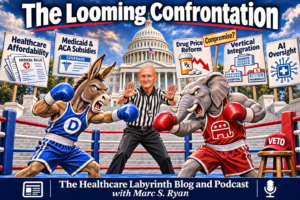
The Healthcare Agenda After the Democratic Wave Wiped Out Republicans

What will come of healthcare as the Democrats take over both houses of Congress In my November 5 blog, I reviewed what I got right and wrong about the midterms. I correctly predicted Democrats would capture both houses of Congress but underestimated the political tsunami. Affordability, including healthcare, helped dismantle the GOP’s majority. As promised, let’s examine what comes next. Democrats could finish with 54 to 56 Senate seats and roughly 260 House seats. That is an incredible achievement not seen for some time. As a side note, I would say that polls again were wrong in 2024 and 2026. It missed both waves. But the prediction markets seemed to have it closer. Polymarket and Kalshi both had very high probabilities of the Democrats’ takeover of both houses. Could prediction markets now be a better way to understand voter and public sentiment? The markets appeared to be more predictive of

Read More »

Available Now

$30.00