
The 2028 proposed rule would take Stars down to 15 measures, test Diamond Ratings in 12 states, and cut projected Medicare Advantage (MA) payments by nearly $107 billion.
I have analyzed regulations from the Centers for Medicare and Medicaid Services (CMS) for decades. I have seen plenty of rules that changed healthcare policy significantly. The proposed 2028 MA and Part D rule may be one of the most consequential I have seen. We already had a major restructuring of Star Ratings coming in Star Year (SY) 2029. CMS now wants to take another 19 measures out a year later, eliminate the Reward Factor, and make it harder for some contracts to reach or keep 4 Stars. At the same time, it wants to test a different quality payment system in 12 states. Earlier that week, CMS put forward a separate rule to revive aggressive risk adjustment audit recoveries. That is a huge double whammy for the MA industry.
Outcomes and competition
CMS is making the case for more competition and a tighter focus on outcomes. I agree with parts of that agenda. I worked for big national plans and respect what they do. There is a case for giving regional plans a better shot at competing. And there are measures in Stars that tell beneficiaries very little about the care they can expect. But I have a hard time calling the loss of nearly $107 billion in projected payments a simple quality program cleanup. When the pressure reaches plan bids, it can reach beneficiaries through supplemental benefits, premiums, cost sharing, and ultimately the number of plans available where they live. I will publish more detailed impact analyses shortly on The Healthcare Labyrinth and Medisolv websites.
Stars was already headed for a big change
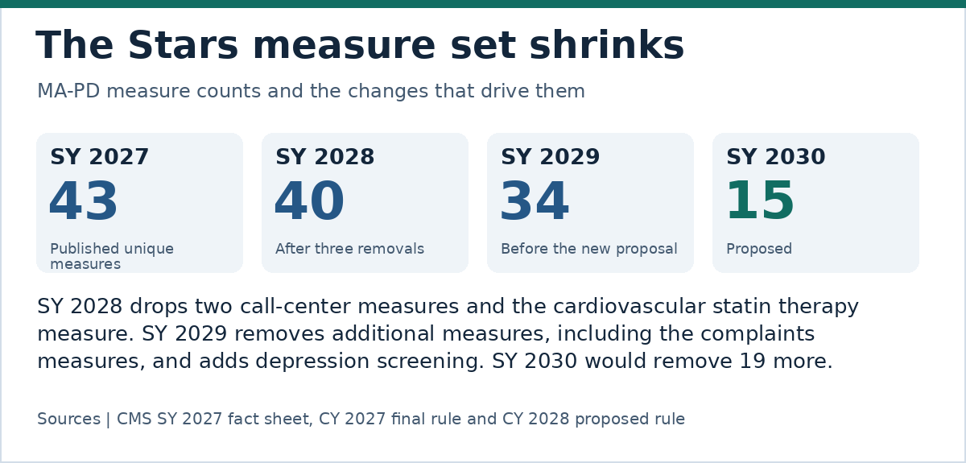
Start with the rule CMS finalized this past April. CMS reported up to 43 unique measures for MA plans that include Part D (MA-PDs) in SY 2027. Using that published count, the measure set goes from 43 in SY 2027 to 40 in SY 2028 and 34 in SY 2029. In SY 2028, the Part C and Part D foreign-language interpreter and TTY call-center measures and the Part C statin therapy measure for cardiovascular disease come out. CMS administratively removed the Part C and Part D complaints measures for SY 2028 recently. In SY 2029, the next round of reductions includes the appeals measures, Special Needs Plan (SNP) Care Management, the Part C and D disenrollment measures, Medicare Plan Finder Price Accuracy, Customer Service, and Rating of Health Care Quality. In SY 2029, Depression Screening and Follow-Up is a new measure and Medication Therapy Management’s Comprehensive Medication Review returns.
The changes that were already on the books had the potential to shake up payments. Wakely used SY 2026 as its starting point and modeled finalized changes through SY 2029. The enrollment-weighted average fell from 4.02 to 3.78, and estimated market-wide MA-PD payments fell 1.2%, or $17.31 per member per month (PMPM), across the modeled changes. Wakely estimated that all 10 of the largest MA organizations would lose revenue in its analysis. It put the SY 2029 step itself at $9.63 PMPM, on top of the changes it assigned to SY 2027 and SY 2028.
Milliman ran a different test using the same SY 2026 Star Ratings as its starting point. It applied the 12 measure removals in the earlier proposed rule to actual SY 2026 results, keeping the existing Reward Factor. In its simulation of payment-linked MA-PD contracts, 164 contracts saw a lower rating, including 134 with lower ratings and revenue. Nineteen gained both. The proposal it modeled still called for removing the diabetes eye exam. That distinction matters when reading the two studies side by side. Both show what can happen when measures on which plans have historically scored well are pulled out. I would expect more turmoil once CMS gets down to 15.
Fifteen measures and a different road to 4 Stars
Most of the Stars changes in the new contract year (CY) 2028 proposal would begin with measurement year 2028 and apply to SY 2030. Most of the quality work relevant to that rating will take place in calendar year 2028. CMS would publish the ratings in fall 2029, and the payment effects would begin in 2031.
What goes. The Part C cuts include breast and colorectal cancer screening, the annual flu vaccine measure, monitoring physical activity, both remaining Care for Older Adults measures (medication review and functional status), osteoporosis management after a fracture, diabetes eye exams, kidney health evaluation for people with diabetes, reducing fall risk, improving bladder control, transitions of care, and depression screening and follow-up. Getting Appointments and Care Quickly and Rating of Health Plan would also go. On Part D, CMS would pull Rating of Drug Plan, Statin Use in Persons with Diabetes, Concurrent Use of Opioids and Benzodiazepines, and the measure of multiple anticholinergics in older adults. Think about the turnaround on depression screening. CMS would introduce it for SY 2029 and pull it one year later.
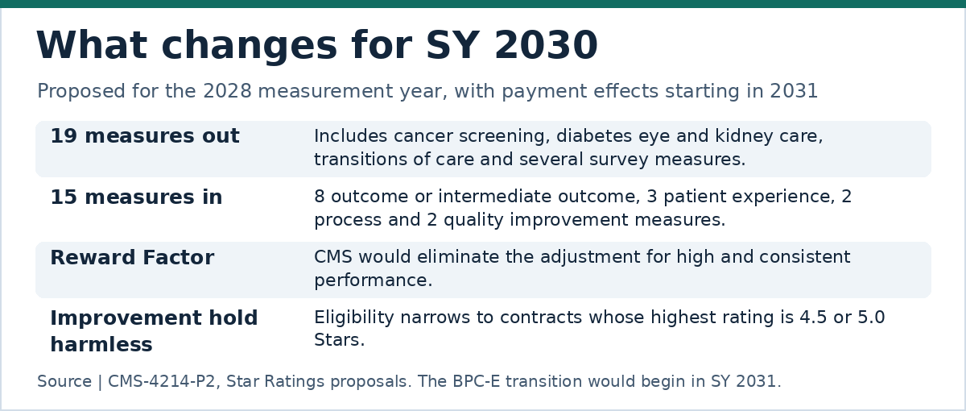
What stays. Eight outcome or intermediate outcome measures survive: maintaining or improving physical and mental health, blood sugar and blood pressure control, all-cause readmissions, and adherence to medications for diabetes, hypertension, and cholesterol. Three patient experience measures remain: getting needed care, care coordination, and getting needed prescription drugs. The two process measures are follow-up after emergency department visits for people with multiple high-risk chronic conditions and completion of a comprehensive medication review. The Part C and Part D quality improvement measures round out the 15. CMS would also replace Controlling Blood Pressure with Blood Pressure Control for Patients With Hypertension (BPC-E), with a broader denominator and Electronic Clinical Data Systems reporting, starting in measurement year 2029 for SY 2031. CMS proposes to collect both blood pressure measures for measurement years 2027 and 2028.
The Reward Factor goes away. The historical factor gives a boost to contracts with high and consistent performance across measures. That boost can matter at a rounding boundary. Just this April, CMS kept the factor in place and decided against bringing in the Health Equity Index reward. Under this proposal, the historical adjustment would disappear in SY 2030. If you use it to get to 4 Stars today, go back and look at your unrounded rating without it. I expect a number of organizations will find that they have less room for error than they thought.
Improvement hold harmless narrows. CMS calculates a contract’s highest applicable rating with and without the quality improvement measures. If the rating without those measures meets the eligibility threshold, the improvement measures can only help the rating. The threshold is 4 Stars today. CMS would move it up to 4.5, leaving contracts at the 4-Star threshold exposed when improvement pulls down the rating. A contract that is performing well but has relatively little room for year-over-year improvement should look especially closely at this. I have heard this dismissed as a small methodology change. For plans on the bubble, that can mean losing quality bonus dollars.
I am particularly concerned about what happens to clinically important measures once they move to display. CMS says it expects plans to continue to support screenings and outreach and proposes ongoing display and monitoring as applicable. In my experience, when the measure drops out of the payment calculation, it gets less attention. Does a breast or colorectal cancer screening outreach program get the same funding in a tight bid year? Does someone still call a member with diabetes who never got an eye exam? Will plans track whether an older adult had a medication review after a hospitalization with the same urgency? You can make the case that plans should pay attention to these measures because the care they track affects costs over time. But life in healthcare is not that easy. I would keep selected prevention and safety measures in Stars or require a credible way to monitor deterioration and act on it.
Insights on the changes
Here are a few things to think through as you plot strategy:
- I have made the case that individual measures contribute more and more to overall ratings as the measure list goes to 34. That is even more the case if the list drops to 15. Every measure counts and 3x measures even more (the new CBP, GSD, IMMH, IMPH, PCR and three adherence measures). This is true of the two improvement measures as well — these become even more critical!
- SNP measures go away. These have increased in performance recently.
- Part D becomes more important, so if you struggle there that hurts you.
- I made the case that you needed to invest in HEDIS, drug, CAHPS, and HOS measures with the SY 2029 restructure. Each was very important. While there are fewer measures proposed in groupings for SY 2029, each grouping remains important to some degree given weights of certain measures.
Who loses under the CMS simulation
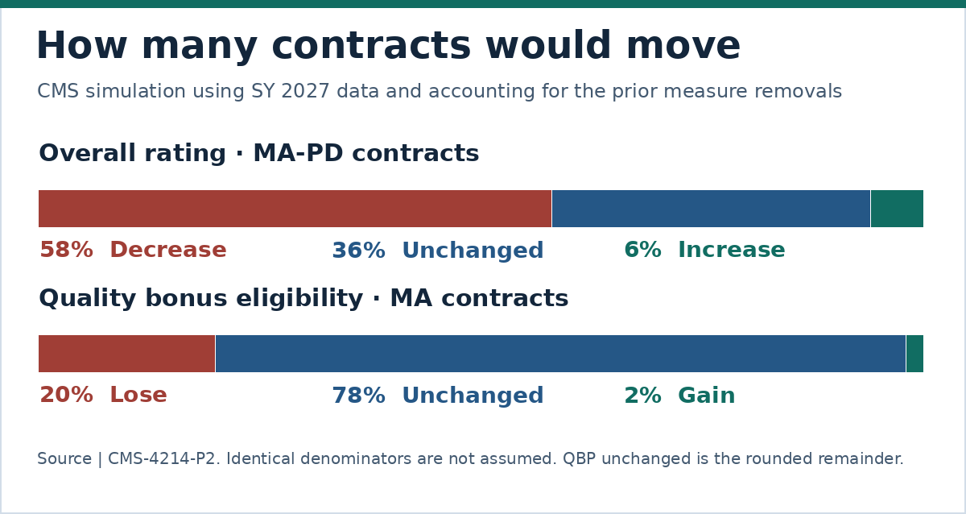
CMS applied the proposed measure and scoring changes to SY 2027 data, also removing the measures that CMS had already finalized for removal. Compared with the published SY 2027 ratings, about 58% of MA-PD contracts would see lower overall ratings, 36% would stay the same, and 6% would rise. About 20% of MA contracts would lose eligibility for a quality bonus payment (QBP), and about 2% would gain it. The corresponding Part D ratings for standalone prescription drug plan contracts would fall for about 47%, rise for 10%, and stay the same for 43%.
For the new SY 2030 Stars changes alone, CMS’s actuaries project $106.96 billion in additional payment reductions over 2028–2037. The estimate uses a baseline that already accounts for the earlier finalized measure removals. CMS projects no payment impact from the new changes in the first three years of that budget window. The estimate starts at $11.50 billion in 2031 and rises to $18.88 billion in 2037. A drop below 4 Stars can cut the benchmark used to pay a plan. A change in rating can also reduce the share of the difference between the plan bid and its benchmark that flows back as rebates. That rebate helps fund benefits, buy down premiums, or reduce cost sharing. The federal score measures lower payments across the industry. What an individual plan loses, and how much of that reaches members, depends on its markets, enrollment, bids, and response. However, my preliminary look so far suggests that enrollment in 4 Star or greater plans drops from just over 70% today to less than one-third in SY 2030 under the proposal. That makes sense when you consider today over $13 billion a year goes out in quality bonus and CMS projects a savings of roughly $11.5 billion in 2031 between rebates and quality bonuses.
No category of plans likely does well. The changes could especially be devastating to many large national plans, which garner the lion’s share of bonus payments due to enrollment size and tend to rely on their budget firepower to ensure operational and easier to hit clinical measures performed well enough to garner the revenue. The operational ones were already programmed to go away; now, many easier HEDIS measures will be gone under the proposal.
ADVaNCE MA and the move to Diamond Ratings
The new mandatory MA model is perhaps the most significant change in the proposal. It signals that quality ratings could look very different in the future. The proposal draws on ideas from the Medicare Payment Advisory Commission (MedPAC), former CMS officials on both sides of the aisle, think tanks, and academics. National plans could have to measure quality and forecast payments under different systems across states. Regional and smaller plans operating across state lines could face the same challenge.
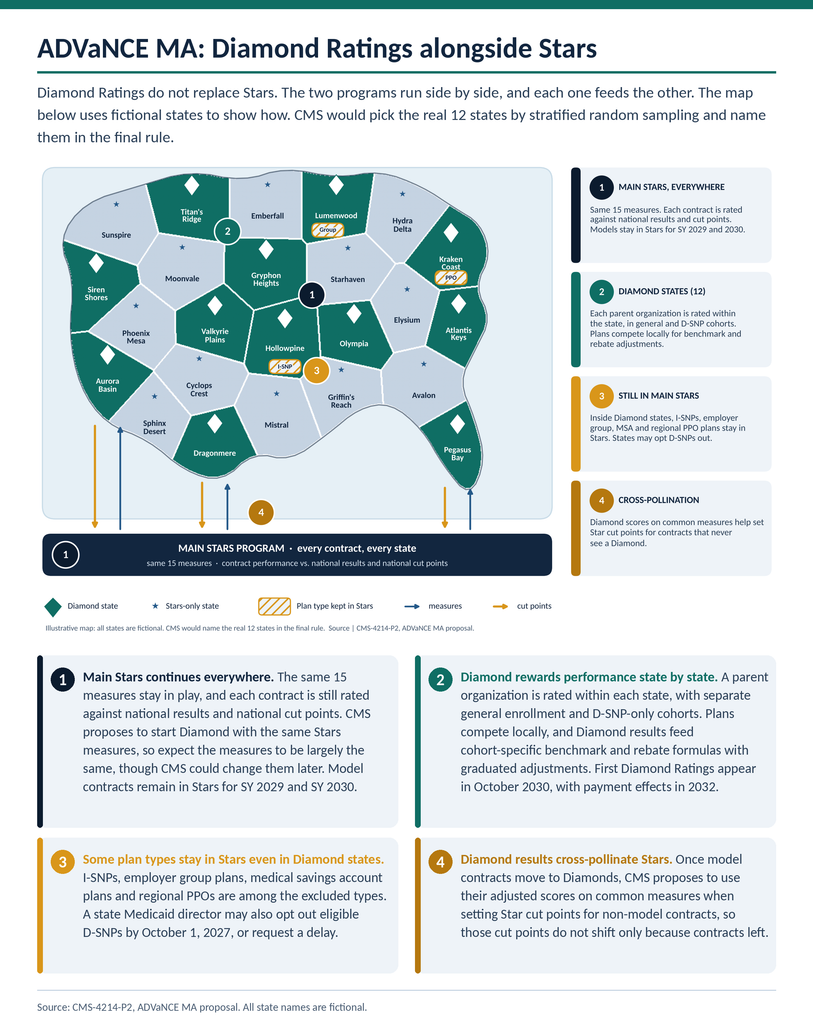
The CMS Innovation Center (CMMI) calls this model Aligning Data and Value to Nurture Competition and Efficiency in Medicare Advantage, or ADVaNCE MA. It would be the first mandatory Innovation Center model in MA. CMS would use stratified random sampling to choose 12 states and would name them in the final rule. The performance period would run from CY 2029 through 2038, with pre-implementation proposed to begin June 8, 2027. Eligible plans in mandatory states would participate subject to the model rules. I-SNPs, employer group plans, medical savings account plans and regional PPOs are among the excluded plan types. A participating state’s Medicaid director could opt out all of the state’s eligible D-SNPs by October 1, 2027, or request a delay under specified circumstances.
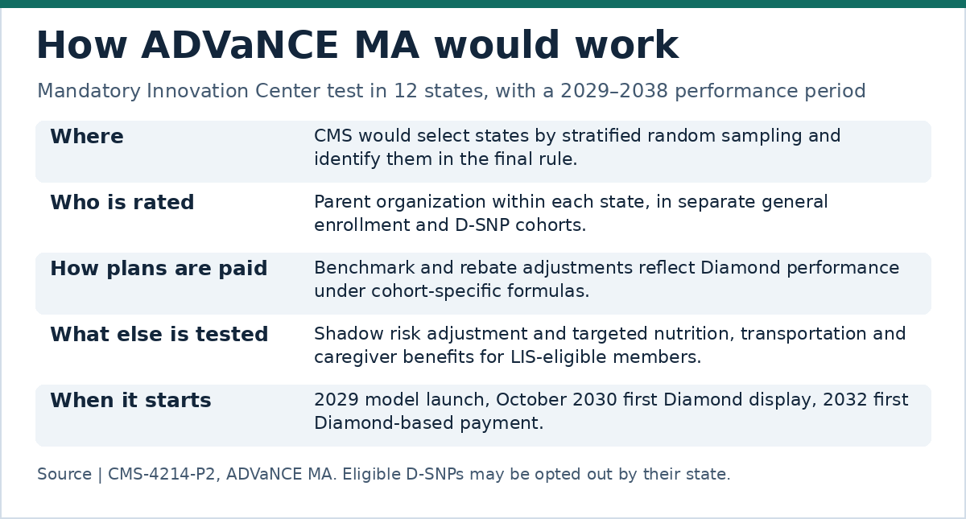
Today a multistate contract can earn a rating that says relatively little about how the organization performs in a given state. Diamond Ratings would evaluate a parent organization within each participating state, with separate cohorts for general enrollment and D-SNP-only contracts. Participants would still be in Stars for SY 2029 and SY 2030. The first Diamond Ratings would appear in October 2030 as the 2031 ratings and would first affect payments in 2032. CMS proposes to begin with the same quality measures used in Stars and could change them over the course of the model.
Diamond performance would feed cohort-specific benchmark and rebate formulas, with graduated adjustments and special rules for small cohorts, low enrollment and new entrants. Plans would have a reason to improve even when they are far from the 4-Star line. There is real merit in that. Rescaling does occur across the 12 states to in part take into account performance differences. But under the proposal, a weak local market and a strong one can produce very different competitive results. I want to see what happens to a good regional plan that is competing against two other good plans in one state and would rank first in another. I worry about how fairly the model would reward equally strong performance across markets and whether it could weaken incentives to improve care.
The test reaches outside the participating markets, too. Once model contracts move to Diamonds, CMS proposes to use adjusted scores from model contracts on common measures in setting Star cut points for non-model contracts. CMS is trying to account for changes attributable to the model while keeping the remaining Stars comparison group from shifting solely because those contracts left. That is a complicated adjustment and forecasting problem for a contract that never sees a Diamond rating. Plans criticize CMS today for not being terribly transparent about disclosing all the calculations and data used in the existing program. Moving forward, the calculations become manyfold more complicated when you have two rating systems as well as ratings at both local and national levels. And then you have Diamond results impacting the base Stars program as well. How complicated that is! And how transparent would CMS really be about all this? I see more Stars lawsuits in the future under the dual system!
There is more here than quality. CMS proposes to shadow test a CMMI Inferred Risk Adjustment Model that draws on Original Medicare claims, MA encounter data, and enrollment data. Shadow testing would leave live risk-adjusted payments in place while CMS assesses the alternative. The model would also let participating organizations target certain healthy food, nonmedical transportation, and caregiver supports to people eligible for the Part D Low-Income Subsidy. CMS is considering a future dialysis carveout for beneficiaries with end-stage renal disease, under which Original Medicare would pay for dialysis and MA plans would remain responsible for other covered care. The agency is seeking input on that idea at this stage. Of these components, I am most interested in whether the risk adjustment test can pay more accurately for people with complex needs while reducing the financial incentives that drive disputes over coding.
The rest of the rule deserves a look
The rule would also change how MA plans enter markets, enroll members, and deliver benefits.
Market entry, enrollment, benefits, and marketing.
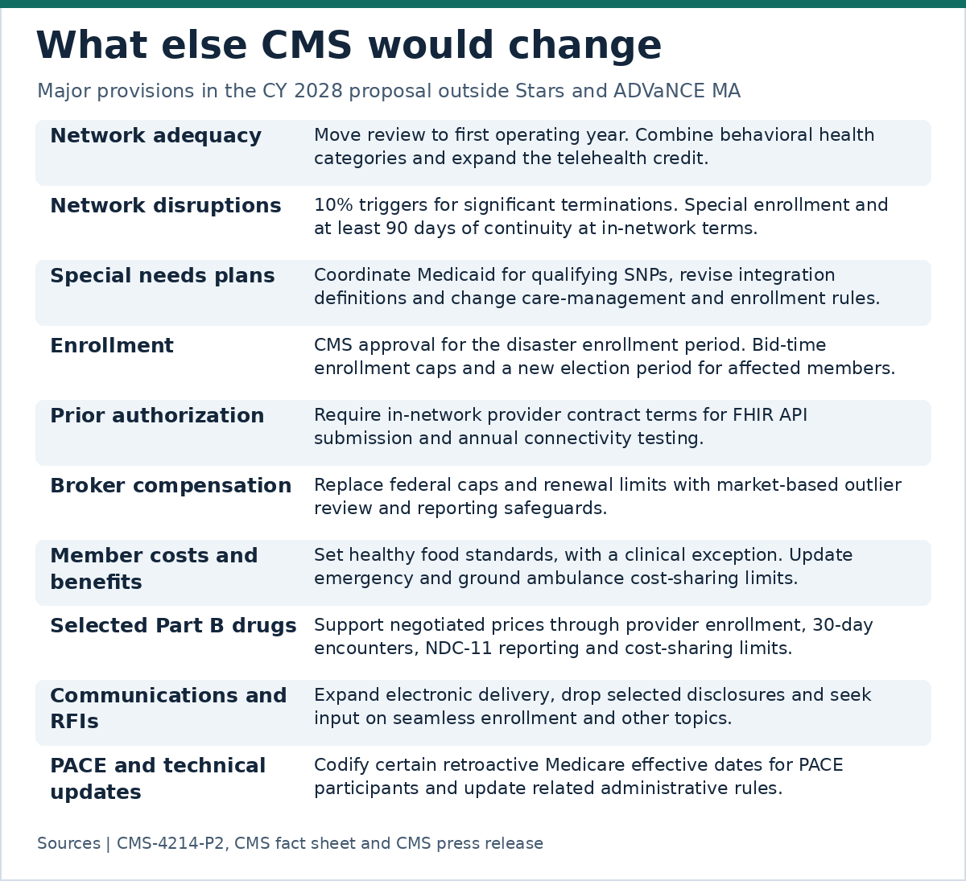
- CMS would take a different approach to market entry by checking network adequacy during the first operational year in a new or expanded service area. It would combine clinical psychology, clinical social work, and outpatient behavioral health into one network category and seek to expand the existing telehealth credit.
- It would also require notice and a special enrollment period for qualifying network disruptions. A termination could trigger the requirement if it affects at least 10% of the plan’s enrolled population or represents at least 10% of its contracted network for a specialty. Eligible members would have at least 90 days of coverage at in-network terms for services from the terminated provider. It would route disaster special enrollment requests through 1-800-MEDICARE for approval, move capacity-limit requests into the bid process, and create an election opportunity for affected beneficiaries turned away by capacity limits.
- It would codify limited retroactive Medicare effective dates for participants in the Program of All-Inclusive Care for the Elderly (PACE).
- A potential same-organization transition into MA from commercial or Exchange coverage is under consideration.
- CMS proposes emergency service cost-sharing caps of $180–$240 and ground ambulance caps in the $180–$300 range, depending on the plan’s maximum out-of-pocket limit. It would also sunset a compound-drug balance-billing protection requirement.
- CMS would expand electronic delivery and remove selected marketing and communications requirements.
Special Needs Plan changes. Certain C-SNPs and I-SNPs with at least 60% dual-eligible enrollment would have new coordination responsibilities for Medicaid, including helping full-benefit duals access supports across settings. CMS would revise model-of-care and health risk assessment requirements, update default enrollment for states moving from Medicaid fee-for-service to managed care, drop the same-legal-entity requirement for fully integrated D-SNPs, and recognize additional affiliations for highly integrated D-SNPs. The agency is also seeking input on allowing a coordination-only D-SNP alongside an integrated D-SNP in the same service area. Medicare and Medicaid should work more closely for dual eligibles. Whether this works will depend on who can arrange and pay for services when a member actually needs them.
Interoperability. CMS would require in-network providers to use a FHIR-based electronic prior authorization API interface, with plans testing connectivity annually.
Broker oversight. CMS would replace federal broker compensation caps and renewal limits with market-based outlier review and more reporting. It would also remove referral fee caps.
Healthy food benefits. The rule would also set a healthy food standard across relevant MA supplemental benefits, with an exception for items specifically recommended by a provider for medical needs.
Part B drug pricing. CMS proposes new provider participation and encounter requirements to implement negotiated prices for selected Part B drugs, including a 30-day submission period and 11-digit drug codes.
Two Stars overhauls and a very big audit bill
So, what are the implications of these changes on the industry?
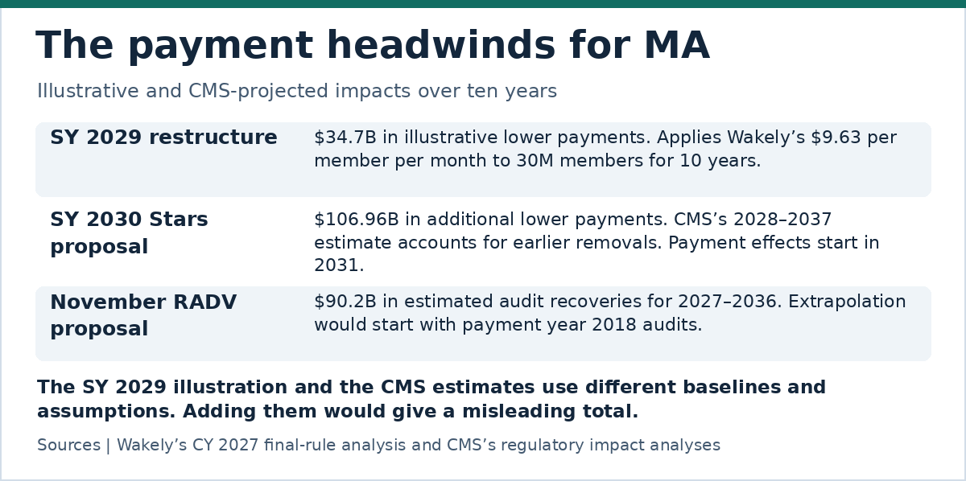
The SY 2029 restructure: CMS’s official score for the combined CY 2027 final-rule Stars changes was an increase in payments of $18.56 billion over 2027–2036. That comparison reflects a baseline in which the Health Equity Index (HEI) reward would have gone into effect and saved taxpayer dollars. In fact, the same rule’s measure removals put pressure on payments when compared with what plans had actually experienced under the historical Reward Factor. For a sense of scale, applying Wakely’s $9.63 PMPM estimate for the SY 2029 step to 30 million members over 10 years yields about $34.7 billion in lower payments. This illustration assumes enrollment and the monthly payment effect stay flat for the full decade.
The SY 2030 proposal: CMS puts the additional payment impact of the new Stars changes at nearly $107 billion for 2028–2037. The baseline already accounts for the finalized measure removals. The Wakely-based illustration uses different assumptions, so adding it to the CMS estimate would give a misleading total.
Risk Adjustment Data Validation (RADV) recoupments: The November RADV audit recoupment proposal would allow CMS to extrapolate findings from a sample of records to the audited contract beginning with payment year 2018, without a fee-for-service (FFS) adjuster. CMS estimates about $90.2 billion in transfers from MA organizations to the federal government over 2027–2036 if the rule takes effect as proposed. The earlier RADV rule was vacated by a federal district court in the Humana case on procedural grounds, and the government appealed. CMS says extrapolation is necessary to recover a meaningful share of improper payments. I support bringing back dollars for diagnoses the record does not support. I have serious concerns about going back to 2018, using no FFS adjustment despite the claims-based calibration of the payment model, and extrapolating unless the sample, error calculation, and appeal rights are fair. Going back years and applying a sample estimate across a contract can turn a documentation dispute into a substantial liability.
What might happen in the final rule?
Given the size and complexity of the undertaking as well as the financial impacts, CMS is likely to make some changes in the final rule. I expect some of the following:
- Restoration of some clinical measures due to comments that preventive testing, clinical oversight, and drug safety is key.
- Possible push out of the smaller measure set until after SY 2030.
- Likely later launch of the ADVaNCE Diamonds Stars due to all the changes occurring in Stars and the time to thoughtfully implement.
- Less or no overlap in the conduct of ADVaNCE and the main program due to concerns over transparency, predictability in the main program, and data sharing.
- Less likely but possible retention of the Reward Factor or changes to the hold harmless proposal (or pushing out implementation of either or both).
- To address potential rating inequities, CMS could address whether a contract in Diamonds truly gets a lower rating in a high quality state than it otherwise would have in the main Stars program (but that adds more complexity).
The bottom line
My bottom line is that I want Medicare Advantage held to high standards. I also want seniors and people with disabilities to retain access to a stable, affordable set of choices. I would ask CMS to show how the new Stars system performs at the contract and member levels, especially near 4 Stars, and how outcomes and access are affected when clinical measures move to display. The regulatory impact analysis gives us a sense of the federal dollars at stake. I want to see what beneficiaries stand to gain or lose alongside it.
The proposal is scheduled for Federal Register publication November 25. Plans, providers, quality leaders, vendors, and beneficiaries can comment under docket CMS-2026-3533, file code CMS-4214-P2. The public-inspection text and the press release describe the 60-day comment period with different starting points. Check the docket for the posted deadline. If you have contract-level evidence, examples of care that improved because a measure was in Stars, or data on what losing a bonus would mean to benefits in a particular market, bring it to CMS. There is a lot at stake here for America, seniors, people with disabilities, and MA plans.
#medicareadvantage #stars #quality #cms #radv #riskadjustment
— Marc S. Ryan