
The GOP fundamentally misread affordability issues, in particular on healthcare
The midterms are Tuesday, November 3. I will offer my final House and Senate predictions Monday, the day before Americans finish voting. But following my earlier election forecast and debt blogs, I wanted to examine an issue that could help determine the outcome: healthcare affordability.
Healthcare is playing an outsized role, both independently and within the broader affordability debate. The polling increasingly explains why Republicans should be worried.
The polls tell a clear story
United States of Care’s (USofC) People’s Health Care Survey finds that 76% of registered voters consider healthcare one of their top three voting issues. Fifty-six percent say healthcare is unaffordable, while 73% feel frustrated, overwhelmed, or helpless about costs. Only 42% of people with employer coverage report satisfaction with their insurance, compared with 66% of Medicare enrollees.
Healthcare policy group KFF’s October polling reinforces the point. Healthcare costs and the cost of living rank as the top two issues voters want candidates discussing. Democrats lead Republicans on trust to address healthcare costs, 42% to 22%. That is a considerable disadvantage heading into an election.
Employer coverage is the much bigger affordability story
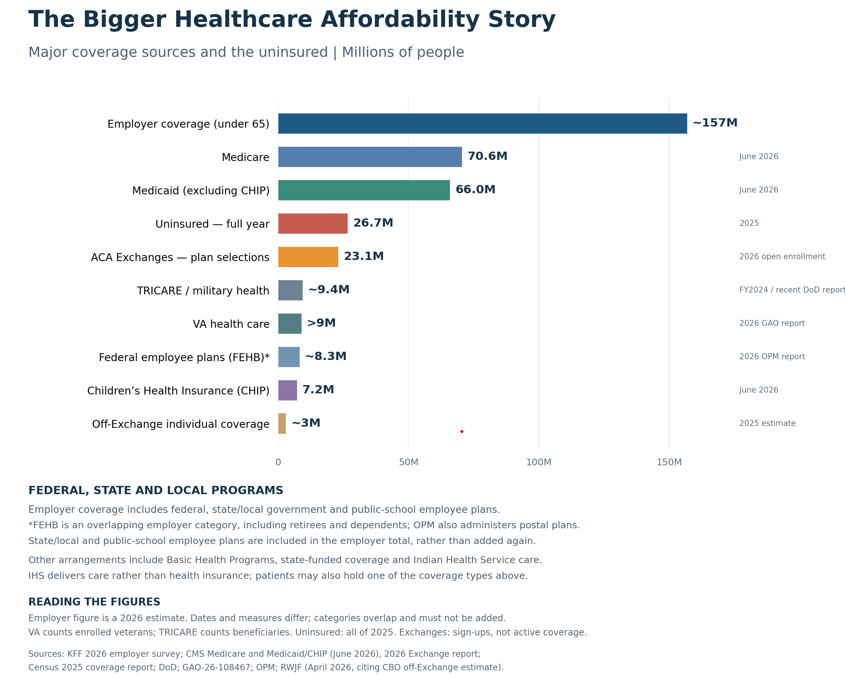
Exchange subsidies attract enormous attention. But employer coverage remains the largest source of insurance for Americans under 65. KFF estimates employer insurance covers nearly 157 million people, compared with 23.1 million Exchange plan selections during 2026 open enrollment. That has since dipped by millions due to unaffordability. Although these are different enrollment measures, employer coverage reaches roughly seven times as many people.
Those families feel rising costs directly. KFF reports average employer family premiums increased 6% to $26,993 in 2025 and another 5% to $28,303 in 2026. Workers’ annual premium contributions climbed from $6,850 to $7,471—a 9% increase this year—before deductibles and other cost-sharing.
Mercer projected average per-employee costs exceeding $18,500 in 2026. Its latest survey, now issued under Marsh, projects another 8.2% increase in 2027, even after employers implement cost-control measures. Employers cannot absorb these increases indefinitely. Workers eventually pay through higher contributions, reduced benefits, or constrained wages.
The uninsured ranks are growing—and underinsurance reaches even further
The latest Commonwealth Fund survey finds the uninsured rate among adults ages 19–64 rose significantly, from 8.9% in 2024 to 11.2% in 2026. These are working-age adult figures, rather than an all-ages national rate, but they provide clear evidence that coverage is moving in the wrong direction. Latest estimates suggest about 30M throughout America are uninsured (adults and children).
More importantly, available estimates suggest roughly 100 million Americans are uninsured, experience coverage gaps, or have insurance that leaves care unaffordable. The precise total varies by definition and timing, but the magnitude of the affordability crisis is unmistakable.
Underinsurance reflects high deductibles or substantial out-of-pocket spending relative to household income. As I always say, an insurance card does not guarantee affordable access. These Americans have coverage yet may still struggle to obtain care without sacrificing other necessities or accumulating debt.
When I wrote The Healthcare Labyrinth (published in 2022), the combined uninsured and underinsured number was somewhere about 85M. While the uninsured rate has gone up, the real change was surging underinsurance as annual healthcare trends erode benefits and drive up premiums, deductibles, and cost-sharing.
Seniors and public-program enrollees feel it too
The standard Medicare Part B premium rose from $185 monthly in 2025 to $202.90 in 2026, affecting traditional Medicare and Medicare Advantage beneficiaries. Average in-network spending limits in individual MA plans also increased from $4,685 in 2023 to $5,421 in 2026, increasing potential financial exposure.
Exchange families have faced the expiration of enhanced subsidies. Medicaid restrictions have begun affecting certain legally present immigrants, with broader work requirements beginning by January 2027. Republicans also misjudged Medicaid’s popularity: KFF’s June 2025 polling found 83% viewed it favorably.
The GOP missed its reform opportunity
Reducing fraud, improper enrollment, and unnecessary spending is essential. But Republicans approached the problem in ways that looked mean and uncaring while largely ignoring employer coverage affordability.
Work requirements do little to address healthcare prices. I support individual coverage health reimbursement arrangements, or ICHRAs, and health savings accounts. But financing options alone cannot make underlying care affordable.
Republicans could have built a serious agenda around price reform, a primary care pivot, and true affordability. Trump’s efforts on drug price reform looked far more serious and convincing than the rest of the healthcare efforts. Instead, the message became withdrawing subsidies and government program access. None of this is to say that Democrats’ approach to healthcare is responsible. It is not. On countless occasions, Democrats have passed legislation that in fact drives the unaffordability crisis. But at the same time, there is little doubt that the GOP has earned the uncaring characterization this election cycle.
President Trump won in considerable part because the Biden administration failed to respond convincingly to affordability issues. His administration and a GOP Congress repeated that mistake. Healthcare has gone from an amorphous and complex issue decades ago to a real pocketbook issue that dominates conversation around the dinner table. It has become exceedingly personal. So Trump’s and the GOP’s healthcare affordability failure becomes personal for families, too. On Tuesday, Republicans will discover just how personal all this has become.
#midterms #healthcare #coverage
— Marc S. Ryan