
Plans’ Star ratings stabilized a bit but challenges remain
Thursday night saw the release of Star Year (SY) 2027 quality performance results for the Medicare Advantage industry, and the news was again not good. For all practical purposes, we are in the fifth year now of poor results coming out of the COVID pandemic and a peak in SY 2022. We did have some notable gainers, who recovered from years of Star doldrums. But other big players saw considerable declines. All things said, the industry was basically flat. The results add to the challenges plans have with declining risk adjustment revenue and rates that are not keeping up with utilization trends.
A high-level barometer look
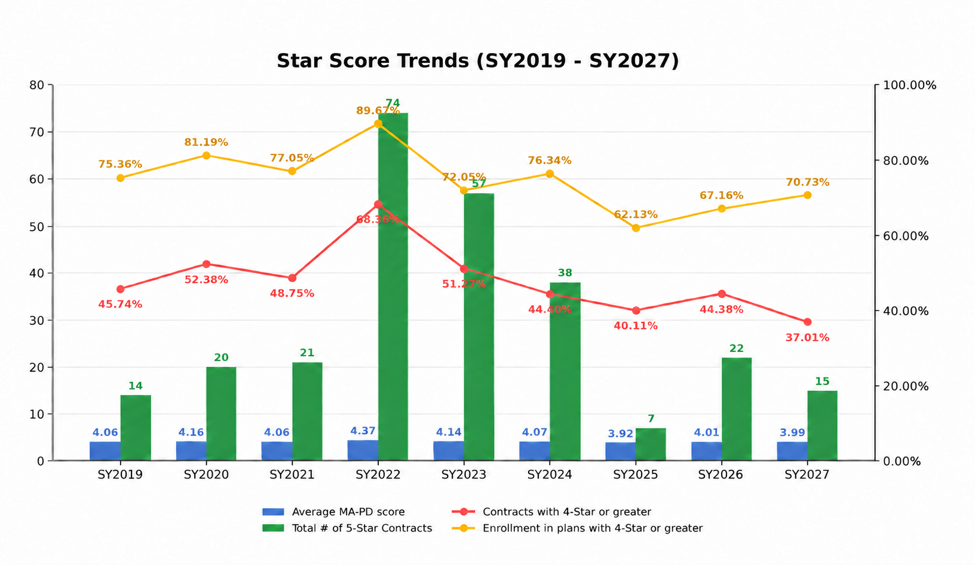
I like to look at three figures the minute results are released. They tend to encapsulate the whole picture. The data throughout this blog compares SY 2027 results to the recalculated “better of” ratings announced in July for SY 2026.
First, the average rating across 508 contracts dropped from 4.01 to 3.99. This shows that quality struggles remain. This is down from a peak of 4.37 in SY 2022. Admittedly, the peak performance years were in part due to the lifting of some requirements during the COVID pandemic.
Second, in SY 2026, 44.38% of contracts were 4-Star or greater. Now it is just 37.01%. This again is the lowest in recent years.
Third, enrollment in 4-Star or greater contracts increases from 67.16% in SY 2026 to 70.73% in SY 2027. This shows that savvy consumers continue to flock to high-performing plans when things deteriorate in the industry. Still, this SY 2027 figure is well below both COVID and pre-COVID rates.
A lot of volatility
Volatility remains a big issue for Stars quality performance.
The SY 2027 results find that:
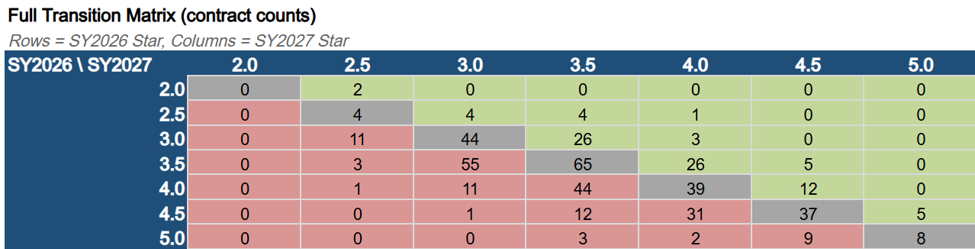
- 88 contracts (19%) increased their rating
- 183 contracts (39%) saw drops in their rating
- 197 contracts (42%) have the same rating
- 40 contracts only had ratings in SY 2027 due to plan exits
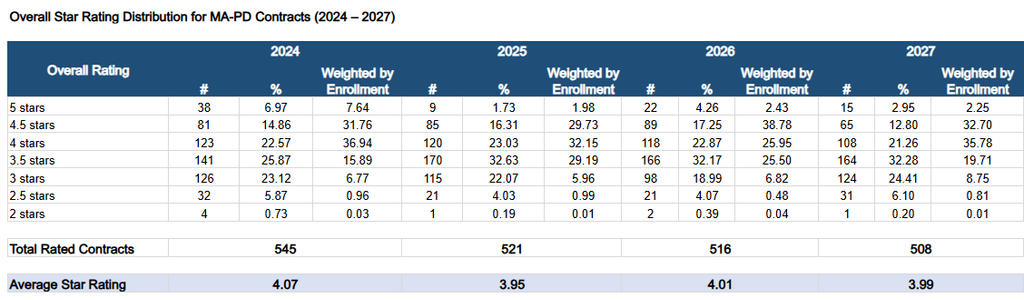
There are 41 fewer contracts in the 4 Star or greater category. There are 33 more 3.5 Star and below contracts.
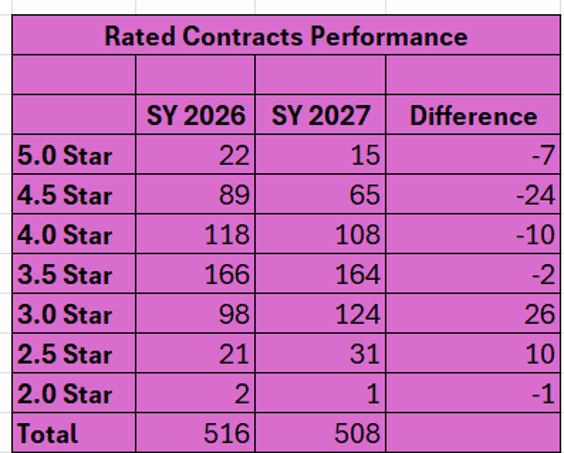
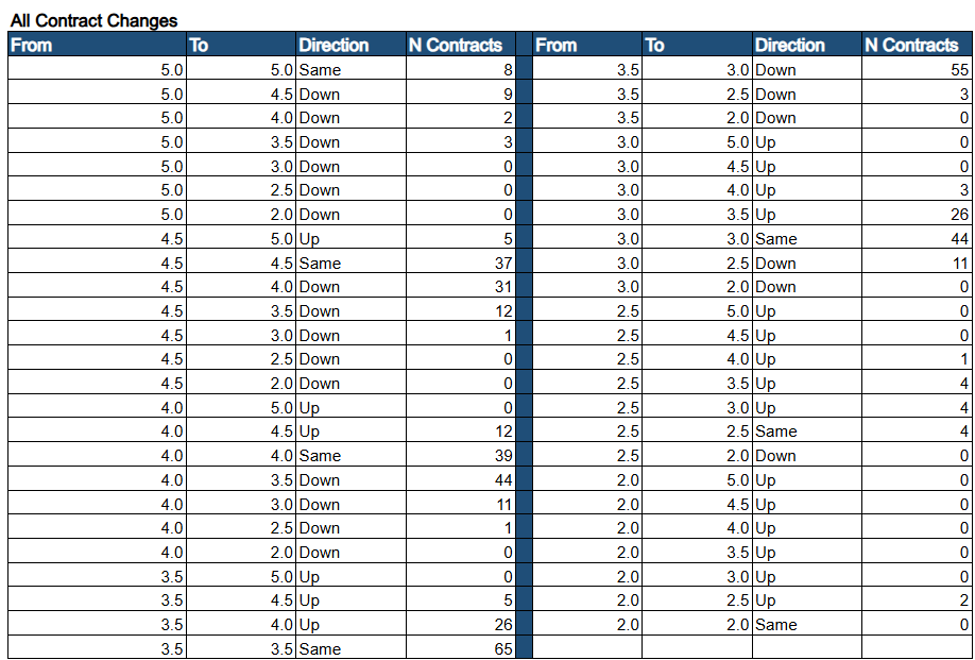
There are 468 contracts rated both in SY 2026 and SY 2027. The chart below breaks out every one of the 468 contracts and their rise or fall in SY 2027 from SY 2026. The rows are the contracts’ ratings in SY 2026. The columns are the contracts’ ratings in SY 2027. Gray represents contracts that stayed the same year over year. Green represents contracts that went up in SY 2027 and Red represents contracts that went down in SY 2027. A simpler view is in the charts just below the next one.
HMO vs. PPO performance
More evidence that plans are struggling, the HMO enrollment-weighted average Star rating slipped from 4.04 to 3.85. MA plans have been shedding PPO products, so the enrollment-weighted average Star rating slipped just .01 to 4.08.

Big plan performance
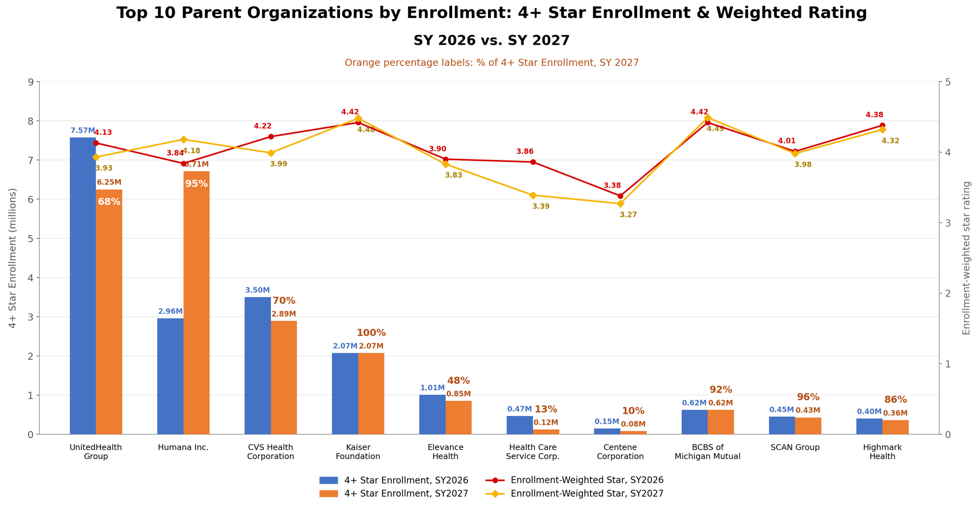
The biggest MA plans had a mixed record in Star Year 2027 as well. Just 3 of the top 10 and 5 of the top 20 parent organizations with the highest enrollment increased their enrollment-weighted ratings. In the top 10, those are Humana, Kaiser Permanente, and BCBS Michigan.
Humana moved its biggest enrollment plan back to 4.0, flipping its 4-Star and greater enrollment from successive years of doldrums to 95%. United saw its 4-Star and greater enrollment drop to 68%. CVS dropped to 70%.
Average measure ratings
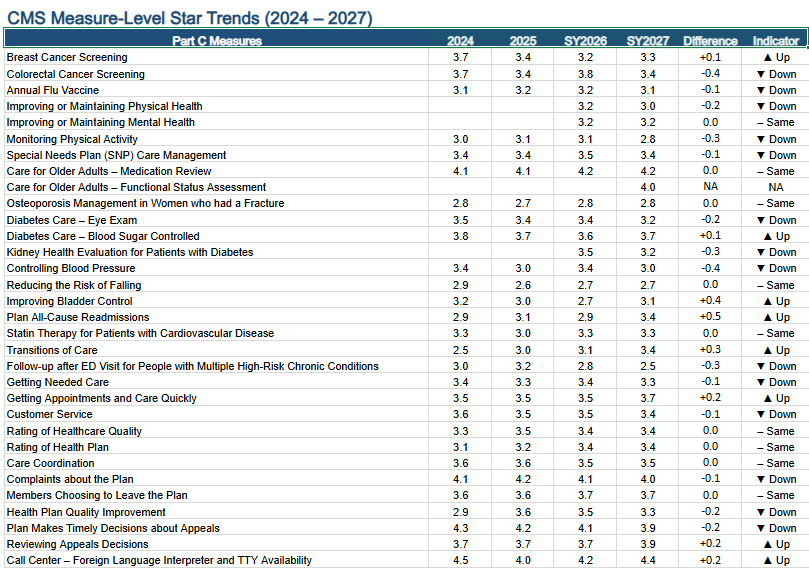
Star Year 2027 had 45 MA-Part D measures — 32 Part C and 13 Part D. Forty measures were common between SY 2026 and SY 2027. Average measure ratings are impacted by both the 2025 retrenchment (which removed some lower performing contracts) as well as overall relative improvement.
In terms of Part C measure average ratings from SY 2026 to SY 2027:
- 8 measures increased, 14 dropped, and 9 stayed the same.
- Notable poorer or lower performing measures include: Colorectal Cancer Screening, Monitoring Physical Activity, Kidney Health Evaluation, Controlling Blood Pressure, and Follow-Up ED Visit.
- Notable higher performing measures include: Improving Bladder Control, Plan All Cause Readmissions, and Transitions of Care.
In terms of Part D measures:
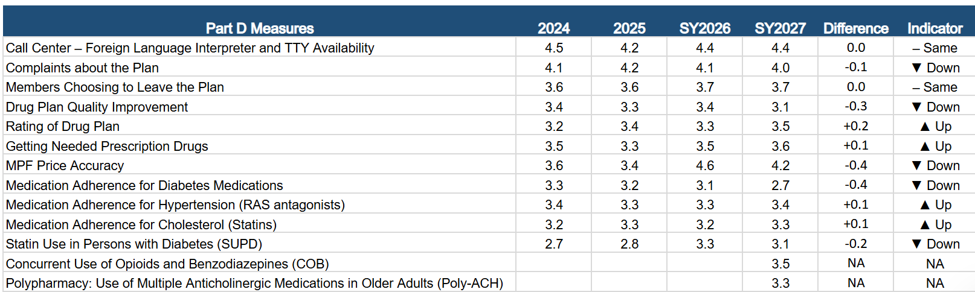
- 4 measures increased, 5 dropped, and 2 stayed the same.
- Notable poorer or lower performing measures include: MPF Price Accuracy and Medication Adherence Diabetes, and Statin Use in Persons with Diabetes.
Both quality improvement measures dropped.
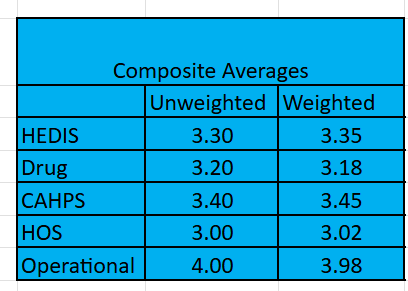
Composite averages
A look at the composites show that plans struggle with high performance on all measures, except operational measures. Clincial measures and HOS survey measures are in the lows 3s, with CAHPS in the mid 3s. This becomes a serious issue in SY 2029 with the Stars restructure. See more below.
Average measure values
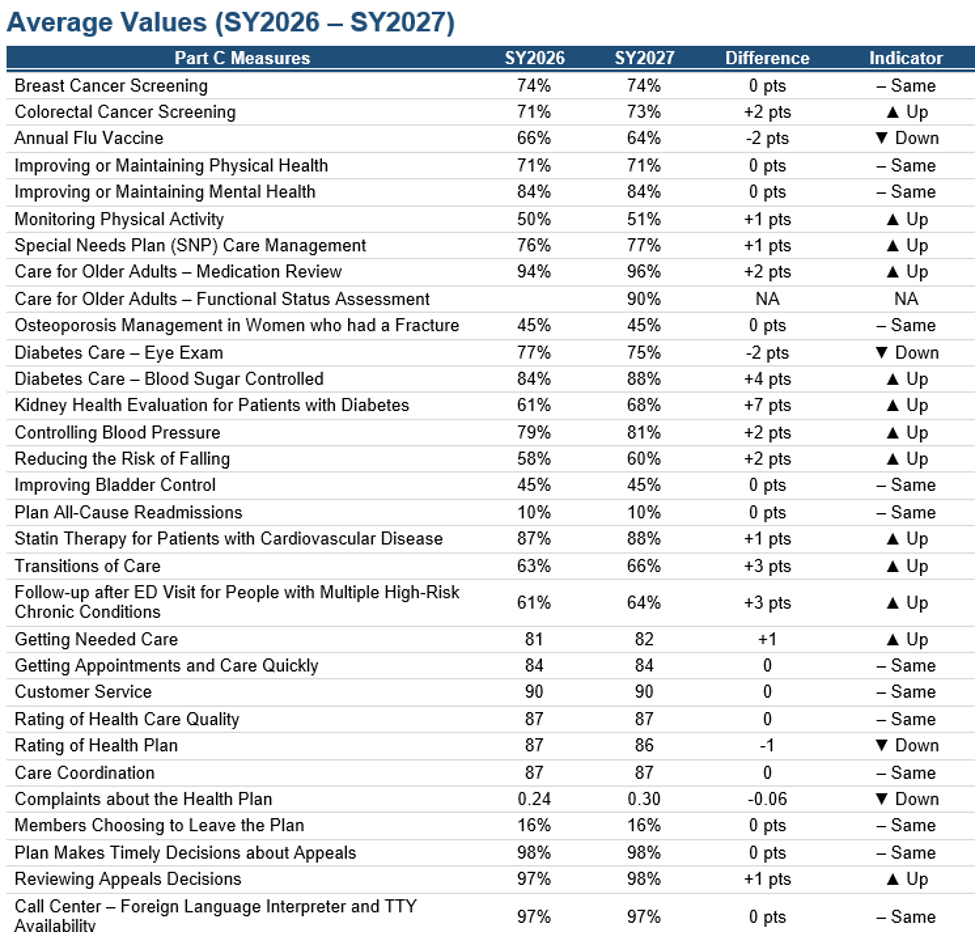
Average measure values are more indicative of overall improvement but also could be impacted by the 2025 retrenchment.
In terms of Part C measure average values from SY 2026 to SY 2027:
- 13 measures increased, 4 dropped, and 13 stayed the same.
- Notable poorer or lower performing measures include: Diabetes Eye Exam and Annual Flu Vaccine.
- Notable higher performing measures include: Diabetes Blood Sugar Control, Kidney Health Evaluation, Transitions of Care, and Follow-Up ED Visit.
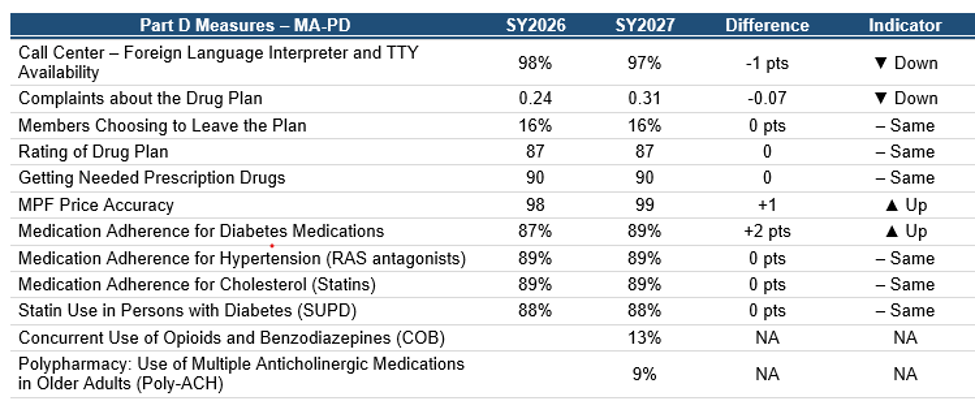
In terms of Part D measures:
- 2 measures increased, 2 dropped, and 6 stayed the same.
- Notable higher performing measures include: Medication Adherence Diabetes.
Challenges moving forward
If the last few years of Star performance was worrisome, many have to deal with the impending restructure of the Star measurement program in SY 2029. Under a new regulation, operational measures and a few others will be retired. The number of measures will drop from 45 in SY 2027 to 34 in SY 2029. Clinical outcomes (in the form of HEDIS and drug measures) will now be about 50% of all rating points. And survey measures will be about 34%. But if you go back up to the composite chart above, you see that clincial measures are mired in the low 3s along with HOS measures. CAHPS measures are in the mid 3s. The composites of the most important measures in SY 2029 are nowhere near the high-performing 4 rating.
CMS says this is the estimated impact on Star ratings in SY 2029 against attainment in SY 2026’s original ratings scenario:
- 62% of contracts will see no impact to Star ratings
- 13% of contracts will see an increase of one-half Star
- 25% of contracts will see a decrease of one-half Star
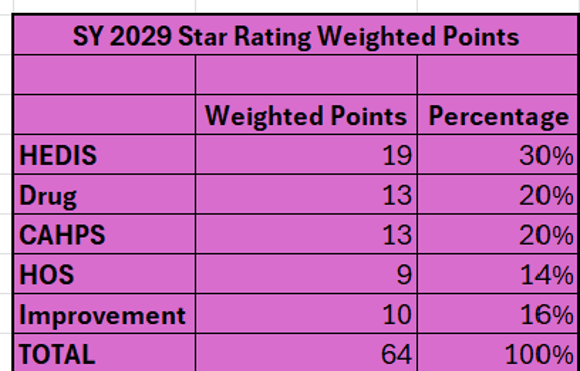
Again, against the original ratings scenario for SY 2026, actuarial firms seem to have concluded that impacts are worse than CMS says. A Milliman white paper shows 30% of contracts could lose half a Star, with a few dropping a full Star. At least 42 contracts would fall below the 4.0 Star level. The number of contracts below 3.5 Stars also increases by 63. And showing the impact on other contracts, the national contract-weighted average for overall Star achievement could decrease by 0.15 Stars.
A Wakely analysis released at about the same time dovetails with the worse impacts found by Milliman. Against original SY 2026, it says the national enrollment-weighted market average for overall Star achievement will drop by 0.25 Stars. This would mean a loss of revenue of 1.4% for MA-Part D (MA-PD) plans and fewer 4 Star plus contracts. The lower Star ratings impact plans of all sizes — top 10, large, mid-size, and small.
And a small number of 3x measures will drive a lot of overall weights:
- Blood Sugar Control
- Controlling Blood Pressure
- Readmissions
- Improving/Maintaining Physical Health
- Improving/Maintaining Mental Health
- Medication Adherence Diabetes SDS Risk Adjustment
- Medication Adherence RASA SDS Risk Adjustment
- Medication Adherence Statins SDS Risk Adjustment
The above are 24 points of 64 total, so 37.5% of all overall rating weighting.
As of SY 2028, the SDS risk adjustment process came in for medication adherence and they return to 3x in SY 2029. Depression Screening and Follow-up, a tough electronic measure, also is introduced in SY 2029.
With Special Needs Plan enrollment growing and a push to establish free-standing SNP contracts, the impacts to SNP plans and those with high penetration of dual eligibles and SNP lives are especially important to consider. Studies indicate that highly penetrated SNP and dual plans have overall ratings that are 0.3 lower on average. Outcomes on certain measures, including drugs, can be even worse than that. With operational measures gone, even lower performance for these plans and more volatility is possible.
New approaches needed
Given the current ratings challenges and the seismic shift in the Stars program, MA plans do need to think differently about their approach. Key best practice strategies include:
- Contract-level impact assessment: Conduct an assessment of contract-specific impacts for your contract(s). Are you one of the plans that loses a half Star on your contract(s) come SY 2029? Does the impact reduce your potential to increase your Star rating over time even if you do not drop a half rating?
- Strategic planning rigor: Planning becomes more of a necessity than before. Ongoing strategic planning during the measure year is key.
- Sustained quality investment: MA plans will need to invest more and consistently in quality improvement budgets. Investments in improvement by measure and holistically at enterprise level capabilities are key.
- Cut point and significance threshold proximity analysis: Plot your strategy by looking at how close you are in a given year and across years to certain higher cut points. Mine the data to see what investments make sense in the current year and into the next. And don’t forget proximity to significance-level thresholds for improvement measures. This can be very valuable in moving your overall rating up.
- CAHPS and HOS prioritization: CAHPS and HOS have been trouble spots for many contracts, but now become a key focus. More than a third of overall ratings achievement are rooted in these measures as of SY 2029 and substantial investment is needed. These measures must be worked over a series of years. Understanding your members and then remediating issues are both required. Particular attention should be focused on the 3x weighted Improving HOS measures. These will be an Achilles’ Heel for many.
- HEDIS and medication adherence execution: That said, HEDIS clinical and drug measures now will be one half of overall ratings. Highly weighted medication adherence measures will require daily attention and the freshest of data. Clinical measures require fresh data and concerted efforts each week and analysis each month to drive changes. The event-based HEDIS measures – PCR, TRC, and FMC — require substantial investment in several areas. On a retrospective basis, review provider group performance for outliers and success stories. On a proactive basis, train on interoperability and documentation in the medical record of admission and discharge notification. Stress the need for patient engagement within 30 days for inpatient admissions and 7 days for emergency room visits. CMS wants to lower the days post discharge for patient engagement on Transitions of Care. Prepare now.
- ECDS readiness strategy: You must have an electronic measure ECDS strategy. NCQA has a goal of converting all hybrid measures to ECDS by MY 2029 and non-hybrid by MY 2030. Many plans struggled with COL conversion in SY 2026 and there will be more of this to come without a coherent strategy and investment. In terms of hybrid measures, CBP could hit in MY 2028 as well as GSD, TRC, and the COAs in MY 2029. Depression screening hits as ECDS in SY 2029.
- Universal Foundation preparedness: Plan now for the further phase-in of Universal Foundation measures. Depression Screening and Follow-up will hit in SY 2029 but more are sure to come. CMS has telegraphed this. Watch, too, for the following, which were once proposed for Star inclusion but not finalized: Initiation and Engagement of Substance Use Disorder Treatment, Initial Opioid Prescribing for Long Duration, and Polypharmacy: Use of Multiple Central Nervous System Medications in Older Adults.
- Monitor other proposed changes: Some plans will also monitor the following changes that could be made that were proposed in the past but not finalized.
- Removing guardrails for non-CAHPS measures when calculating cut points. This was not finalized as part of the 2026 MA and Part D rule.
- Removing “with and without improvement” for 4- and 4.5-Star plans, effectively requiring improvement in calculations for all plans other than 5 Star plans. This was not finalized as part of the 2025 MA and Part D rule.
- The Clover controversy will require ongoing assessment: It appears that one of Clover Health’s contracts received preferential treatment for SY 2029 ratings. Clover says CMS did not count the 20 measures challenged in the lawsuit in the calculation of its biggest PPO contract. There are updated briefs and filings in the SY 2026 filings for the following: (1) the CMS appeal of the Clover decision, (2) Elevance Health’s suit asking for the same treatment as Clover, and (3) Scan’s and Alignment’s suits asking for a stricter application of the Clover ruling. I will analyze these and have a blog on this soon. MA plans will need to monitor not only the SY 2026 litigation but also how they continue to do on various scenarios in play legally moving forward. That Clover was given a different calculation again will mean MA plans likely file new lawsuits for SY 2027.
#medicareadvantage #cms #stars #quality
— Marc S. Ryan