Marc Ryan

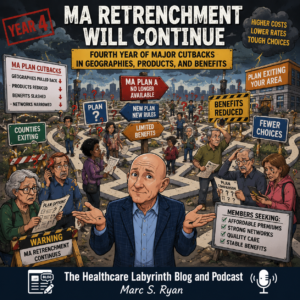
Medicare Advantage Retrenchment Is Not Over — 2027 Could Bring Another Tough Year

2027 will be four years running for cubacks in MA If Medicare Advantage plans thought 2027 would finally mark the end of the industry’s painful retrenchment, they may want to think again. The early signs point toward another year of significant market exits, benefit changes, network adjustments and efforts to control enrollment. And this isn’t exactly new. Medicare Advantage has essentially been going through a multi-year reset since 2024. Rising utilization, inadequate rate trends, the new risk adjustment model, other worries on risk adjustment recoupment, deteriorating Star ratings, and other regulatory changes hit an industry that had expanded aggressively during the preceding years. The result has been a painful process of getting the economics back in balance. 2027 looks increasingly like year four of the MA reset The problems really emerged in 2024, when medical utilization increased far beyond what some insurers had anticipated. Seniors returned for procedures and services

Read More »
Logo

August 21, 2026

Scan Execs Frame What Needs To Be Done With Stars A great Healthcare Forefront blog by Scan CEO Sachin Jain and his chief legal officer discussing the current state of Medicare Advantage (MA) Stars, the various litigation, what is wrong with the Centers for Medicare and Medicaid Services’ (CMS) approach, and what the agency should do about it. They argue CMS has made the program such that sophisticated plans cannot reliably reconstruct how a score is produced. It notes the legal quandary CMS finds itself in post the Clover decision. The Scan execs argue that CMS needs to step back and remake the system based on a smaller number of clinical measures and member experience. As they note, CMS is moving toward this with the SY 2029 restructure. CMS now needs to correct the legal and regulatory deficiencies. #medicareadvantage #stars #quality #cms https://www.healthaffairs.org/content/forefront/stars-docket-medicare-advantage-quality-ratings-trial CMS Pushing Exchange Disenrollments The Centers for

Read More »
Logo

August 20, 2026

More Carriers To Reduce MA Footprint in 2027 Humana and Centene both announced they will reduce their Medicare Advantage (MA) footprint in 2027. Centene will exit in Oklahoma, Tennessee, and Hawaii, cut 158 counties and cancel 133 plans, impacting 340,000. Humana will reduce its county penetration and impact 600,000. All this is tied to a retrenchment to get to profitability. #medicareadvantage #margins #enrollment https://www.modernhealthcare.com/insurance/mh-centene-medicare-advantage-plans-states Aon Says Employer Healthcare To Rise Almost 10% A clear data point that healthcare costs remain out of control. Aon estimates that employer healthcare costs will rise 9.5% in 2027, averaging more than $19,000 per employee. Aon says the surge is tied to higher patient volumes, more individuals with chronic conditions, and more expensive prescription drugs. Hikes were 9.5% in 2026, 9% in 025 and 8.5% in 2024. Additional article: https://www.modernhealthcare.com/insurance/mh-employer-healthcare-costs-2027-aon/ #employercoverage #costs #healthcare https://www.beckerspayer.com/financial/employer-healthcare-costs-to-top-19k-per-worker-5-things-to-know/ Oregon Approves Huge Exchange Premium Surge Oregon regulators approved an average 21.6%

Read More »

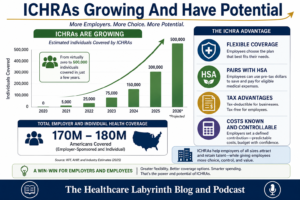
ICHRAs Growing And Can Be Part Of The Healthcare Reform Solution

ICHRAs growing and respond to affordability issues Individual Coverage Health Reimbursement Arrangements (ICHRAs) are getting more attention. And they should. I think ICHRAs are an interesting option that can expand coverage and give employees more choice. But as with almost everything in healthcare, we should distinguish between changing who pays for healthcare and actually making healthcare more affordable. That is an important part of the healthcare debate. What is an ICHRA? An ICHRA, just rebranded as CHOICE Arrangements or Custom Health Option and Individual Care Expense, allows an employer to provide employees with a defined amount of tax-advantaged money that employees can use to purchase individual health insurance coverage rather than enrolling in a traditional employer-sponsored group plan. In some ways, it is the healthcare equivalent of the shift from defined-benefit pensions to defined-contribution retirement plans. The employer establishes its contribution, while the employee has more responsibility—and potentially more choice—in

Read More »

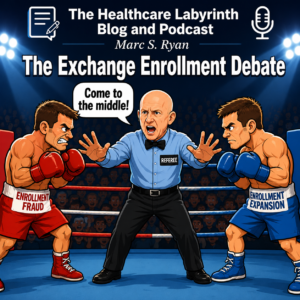
141. The Exchange Enrollment Debate: The Truth Is Somewhere in the Middle.

As usual in politics and public policy, the truth of the Exchange enrollment debate is somewhere in the middle. About The Podcast: Millions of Americans feel confused and frustrated in their search for quality healthcare coverage. Between out-of-control costs, countless inefficiencies, a lack of affordable universal access, and little focus on wellness and prevention, the system is clearly in dire need of change. Hosted by healthcare policy and technology expert Marc S. Ryan, the Healthcare Labyrinth Podcast offers accessible, incisive deep dives on the most pressing issues and events in American healthcare. Marc seeks to help Americans become wiser consumers and navigate the healthcare maze with more confidence and certainty through The Healthcare Labyrinth website and his book of the same name. Marc is an unconventional Republican who believes that affordable universal access is a wise and prudent investment. He recommends common-sense solutions to reform American healthcare. Tune in every

Read More »
Logo

August 19, 2026

Provider Wins In NSA Disputes Becoming Outlandish More evidence that the terribly flawed No Surprises Act dispute process is getting more outlandish, yet lawmakers lack the courage to fix it. Meanwhile, awards continue to drive costs in the system in two ways – the sheer cost of the awards and driving up price points in the system overall. A new federal analysis says disputes rose almost 75% to more than 2.5 million from 2024 to 2025. CMS originally projected just 17,000 cases a year when the law passed. Providers won 83.6% of disputes in Q4 2025, roughly consistent since 2023. Provider groups of course claim the dollars awarded are merited. Health plans say providers are abusing the system and the process is incredibly slanted to providers.  A long-delayed reform rule is likely destined to do little to change the paradigm. It is also true that a small subset of certain

Read More »
Logo

August 18, 2026

JD Power Finds Decline in MA Satisfaction A new study by JD Power finds that satisfaction with Medicare Advantage (MA) plans has declined for a second year. Overall satisfaction was 611 on a 1,000-point scale, down 12 points from the 2025 report and 41 points from 2024.  The study identified declines across the member experience, with the steepest declines over two years in how much the plan is saving time and money (down 51 points); level of trust (down 49 points); and coverage options to meet individuals’ needs (down by 47 points). The decline is obviously related to major cutbacks in access and benefits as the industry grapples with realignment and margin recovery. In other news, Modern Healthcare covers the Q2 financial recovery by plans and outlook for continued improvement. I covered this topic in a blog here: https://www.healthcarelabyrinth.com/are-insurers-turning-the-financial-corner-yes-but-there-is-more-work-to-be-done/ . Additional article: https://www.fiercehealthcare.com/payers/jd-power-member-satisfaction-medicare-advantage-plans-continues-slide #medicareadvantage #margins https://www.modernhealthcare.com/insurance/mh-unitedhealth-humana-aetna-medicare-advantage-2027 PA Rule Clarified The

Read More »
Logo

August 17, 2026

Trump Reining In Medicaid Waivers, Further Complicating State Medicaid Budgets The Centers for Medicare and Medicaid Services (CMS) is paring back on 1115 research and demonstration waivers. Critics say this could increase enrollee churn, undercut finances for providers, and impact innovation. States are already grappling with work requirements as well as reductions to provider taxes used to fund the state share or contribution. The administration argues that the Medicaid footprint has grown considerably over the years, funded inappropriate areas, and has not lived up to budget neutrality.  The administration has defunded social needs waivers and will not renew continuous coverage enrollment.   CMS has informally notified Arkansas that its private option Medicaid expansion under the Affordable Care Act of 2010 will not be renewed. Arkansas is seeking a two-year extension after CMS rejected its five-year renewal. It impacts 200,000 enrollees. In other news, California’s Medicaid program, Medi-Cal, will reduce its

Read More »

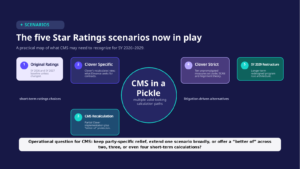
The Stars Fallout Gets Messier: Clover, Elevance, SCAN, Alignment—and the Scenarios CMS Now Has to Navigate

The fallout from the Clover Health Medicare Advantage (MA) Star Ratings decision has become considerably more complicated. What started as one health plan challenging its 2026 Star Rating has now developed into a series of lawsuits that could force the Centers for Medicare & Medicaid Services (CMS) to confront not one, but several competing approaches to calculating Star Ratings. And with Star Year (SY) 2027 ratings approaching, CMS may soon have to decide whether—and how—to extend any of those approaches across MA contracts. The important point is that the plans are not all asking for the same thing. That is where this story gets interesting and potentially very messy. I described this in an earlier blog as the Balkanization of Star measurement. Clover created the opening Clover filed its lawsuit in November 2025 after its largest MA contract received a 3.5 Star rating for 2026. On May 27, 2026, Judge

Read More »
Logo

August 14, 2026

KFF Finds $60B At Risk With Directed Payment Reforms Healthcare policy group KFF finds that an estimated $60 billion in federal Medicaid spending in 37 states (including the District of Columbia) would likely exceed new federal limits on state directed payments for hospital services once fully implemented under the One Big Beautiful Bill Act (OBBBA). The eight states with the biggest potential reductions in Medicaid payments to hospitals are: California ($7.4 billion), Illinois ($4.0 billion), Kentucky ($3.9 billion), Texas ($3.5 billion), North Carolina ($3.4 billion), Louisiana ($3.3 billion), Arizona ($3.0 billion) and Michigan ($2.6 billion). This accounts for about half of the total. While controversial, there is little doubt in my mind that intergovernmental transfers, provider taxes, and state directed payments have been abused by many states and some reforms are needed. Additional article: https://www.kff.org/medicaid/analysis-at-least-37-states-have-medicaid-state-directed-payments-for-hospital-services-that-could-be-reduced-by-the-2025-reconciliation-law-limits/ #medicaid #obbba #healthcare #coverage https://www.kff.org/medicaid/at-least-37-states-have-medicaid-state-directed-payments-for-hospital-services-that-could-be-reduced-by-the-2025-reconciliation-law-limits/ KFF Studies PA Denials A new analysis by healthcare policy

Read More »

Available Now

$30.00