Marc Ryan

Logo

April 8, 2026

CMS Understood Rate Impact on MA More evidence that the Centers for Medicare and Medicaid Services (CMS) understood the potential impact of a zero-rate hike on Medicare Advantage (MA) benefits and cutbacks in 2027. The agency raised the rate hike to about 2.5% by amending its proposal for more aggressive risk adjustment and v28 model changes. This means payments will move from basically a zero increase to $13 billion, just over half of what 2026 will see. CMS clearly listened to plan complaints about the proposed model changes. Plans argued cost recognition would not be correct if the model were adopted. CMS could still adopt this in the future. And as I noted, most plans will see more than 2.5% because the unlinked chart change that was adopted hits big plans much more given their risk adjustment practices. Experts say UnitedHealthcare faces a $5 billion reduction and Humana $2 billion. Still,

Read More »
Logo

April 7, 2026

Insurers Say PA Reforms Taking Hold The two main insurer trade groups say definitive progress is being made to implement voluntarily agreed-upon prior authorization (PA) reforms. AHIP and the Blue Cross Blue Shield Association released a report that found leading health plans reduced prior authorizations for an array of services by 11% since the pledge was made. This equates to 6.5 million fewer prior auth requests for patients. Reductions in Medicare Advantage were 15%. The insurers say that PAs were removed where there were clear clinical guidelines and consistent utilization trends for providers. The groups say insurers have introduced more consumer-friendly language and appeals steps. About 50 plans signed on to the initiative, including all six of the largest, publicly traded plans. #priorauthorization #healthplans https://www.fiercehealthcare.com/payers/insurers-have-eliminated-11-prior-authorizations-under-reform-pledge Wakely’s BALANCEd Assessment Wakely released a great analysis on what health plans need to consider if they join the BALANCE model, which would bring GLP-1 coverage

Read More »
Logo

April 6, 2026

2027 Final Rates Out! A Modest Increase Added The Centers for Medicare and Medicaid Services (CMS) released its Final Announcement for calendar year (CY) 2027 rates for Medicare Advantage (MA). I had predicted that rates would end up between 2% and 3% as the Effective Growth Rate (EGR) would increase markedly between the advance and final notices. The EGR rate actually did not increase much — 0.36%. But rates before risk score trends will go up by 2.48% (vs. 0.09%) because CMS will not implement further changes to the v28 risk model for CY 2027. In its advance notice, CMS proposed to update the Part C risk adjustment model using more recent underlying original Medicare data (updated from 2018 diagnoses and 2019 expenditures to 2023 diagnoses and 2024 expenditures). This would recognize more current costs. Instead, for CY 2027, CMS will continue to use the 2024 MA risk adjustment model which

Read More »

CMS Finalizes 2027 MA And Part D Rule

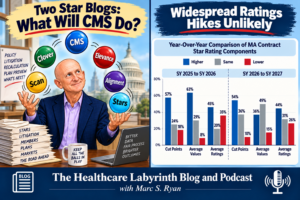
NOTE: This blog is co-published in collaboration with Lilac Software, now part of MediSolv. To learn more about Lilac’s Stars data analytics and agentic AI solutions, visit https://lilacsoftware.com Star Rating changes will lead to major volatility and revenue loss for many MA plans The Centers for Medicare and Medicaid Services (CMS) finalized the 2027 Medicare Advantage (MA) and Part D rule. While much of the rule did not have earth-shattering changes, it is safe to say that the major Star ratings reforms will have far-reaching impacts on MA plans for years to come. Star changes Let’s first inventory the Star changes. The proposed rule changes were all adopted with just one exception. CMS says these changes refocus the program on clinical care, outcomes, and patient experience where meaningful performance differences exist across contracts and reduce administrative burden by removing measures that provide little meaningful distinction between plans.  The changes break

Read More »
Logo

April 3, 2026

White House Wants To Reduce HHS Budget In a long-delayed budget blueprint for federal fiscal year 2027, the White House is asking Congress for a $15.8 billion discretionary budget cut for the Department of Health and Human Services, which is 12.5% lower than this year and eliminates many programs. Major reorganizations are again proposed. A major change would be the move of the growing 340B program to the Centers for Medicare and Medicaid Services (CMS). That is a fair change given the out-of-control nature of the program and the nexus to government program payments at CMS. A new agency, the Administration for a Healthy America, would be established and oversee health priorities currently managed by multiple agencies. That, too, is not a bad idea and should be considered. The administration says the cuts will eliminate “bloated, woke and inefficient programs” and refocus on core priorities. But Senate Appropriations Chair Susan

Read More »

121. Dr. Oz’s CMS Revolution

While some may disagree with the strategies, there is little question Dr. Oz is carrying out a revolution at CMS. Change is needed. About The Podcast: Millions of Americans feel confused and frustrated in their search for quality healthcare coverage. Between out-of-control costs, countless inefficiencies, a lack of affordable universal access, and little focus on wellness and prevention, the system is clearly in dire need of change. Hosted by healthcare policy and technology expert Marc S. Ryan, the Healthcare Labyrinth Podcast offers accessible, incisive deep dives on the most pressing issues and events in American healthcare. Marc seeks to help Americans become wiser consumers and navigate the healthcare maze with more confidence and certainty through The Healthcare Labyrinth website and his book of the same name. Marc is an unconventional Republican who believes that affordable universal access is a wise and prudent investment. He recommends common-sense solutions to reform American healthcare. Tune

Read More »
Logo

April 2, 2026

CMS Finalizes 2027 MA And Part D Rule The Centers for Medicare and Medicaid Services (CMS) finalized the 2027 Medicare Advantage (MA) and Part D rule. Next week, I will publish a detailed blog on the changes between the draft and final rules. The major Star ratings changes were adopted, including the cancellation of the Excellent Health Outcomes for All (EHO4all) reward while maintaining the Reward Factor as well as the sunset of numerous measures. All of the proposed measure terminations were adopted except the Diabetic Eye Exam measure was maintained. Depression Screening will also be added. Most changes occur in Star Year 2029. In other news, CMS announced Maximus will no longer be the Part C Independent Review Entity (IRE). C2C will take over, which also is the Part D IRE. Additional articles: https://www.beckershospitalreview.com/legal-regulatory-issues/cms-finalizes-2027-medicare-advantage-and-part-d-rule-10-notes/ and https://www.beckerspayer.com/payer/medicare-advantage/cms-awards-ma-independent-review-contract-to-new-vendor/ and https://www.cms.gov/newsroom/fact-sheets/contract-year-2027-medicare-advantage-part-d-final-rule (Some articles may require a subscription.) #medicareadvantage #stars #quality #cms https://www.modernhealthcare.com/politics-regulation/mh-cms-medicare-advantage-star-ratings-2027

Read More »

Healthcare Spending Comparison

More confirmation of America’s excessive spending on healthcare A short blog today to update you on healthcare spending around the developed world based on a new Peterson-KFF Health System Tracker chart collection recently published. I have covered this topic of spending and quality in the past many times. What did Peterson-KFF find last time on costs? In the earlier analysis, Peterson-KFF found the following: What did Peterson-KFF find last time on quality? Peterson-KFF finds that the U.S. performs worse in long-term health outcomes measures (e.g., life expectancy), certain treatment outcomes (e.g., maternal mortality and congestive heart failure admissions), some patient safety measures, and health system capacity. On the other hand, the U.S. performs similarly to or better than peer nations in other measures of treatment outcomes (e.g., mortality rates within 30 days of hospital admission) and some patient safety measures (e.g., post-operative complications). In essence, if you have good access

Read More »
Logo

April 1, 2026

Elevance Gets A Reprieve Elevance Health avoided sanctions for now, including an enrollment and marketing freeze, after the Centers for Medicare and Medicaid Services (CMS) granted the Medicare Advantage (MA) plan an extension to make up for incorrect risk adjustment data reporting. Elevance has until May 30 to remediate the issues. At the same time, a bipartisan group of senators is urging CMS to work with Congress to crack down on overpayments in MA. Further, a lawsuit alleging Elevance Health’s Carelon Behavioral Health misled beneficiaries about the scope of its provider network was allowed to move forward by a judge. Additional article: https://www.healthcaredive.com/news/elevance-sidesteps-medicare-advantage-sanctions-cms/816324/ and https://www.fiercehealthcare.com/payers/blue-cross-plan-accused-perpetrated-fraud-ghost-network-class-action-lawsuit and https://www.modernhealthcare.com/insurance/mh-carelon-behavorial-ghost-network-lawsuit-elevance/ (Some articles may require a subscription.) #medicareadvantage #riskadjustment #overpayments #elevancehealth https://www.healthcaredive.com/news/bipartisan-senators-cms-crack-down-medicare-advantage-overpayments-upcoding/816336 Hospitals DSH It Out To HHS Over 130 hospitals are suing the Department of Health and Human Services (HHS) over a 2024 rule involving changes to how payments to hospitals treating a

Read More »
Logo

March 31, 2026

Gallup Finds Healthcare Affordability Tops Concern List A new Gallup Poll finds that Americans are more concerned about the availability and cost of healthcare than any other domestic issue. It is now issue number 1 in Americans’ minds. This has not happened since 2020. About 61% of the 1,000 adults surveyed said they worry a “great deal” about accessing and affording healthcare, while 23% expressed a “fair amount” of concern. About 51% of respondents said they were concerned a “great deal” about the economy and 50% said the same about inflation. The change comes as premiums surge throughout healthcare and enhanced Exchange subsidies expired. In other news, healthcare tech company Cedar surveyed 4,150 patients across the U.S. and analyzed 1.5 billion patient interactions. Nearly 40% of healthcare collections now come from uninsured patients, up 54% in the past three years. Also, states are paying contractors such as Deloitte, Accenture, and

Read More »

Available Now

$30.00