Marc Ryan

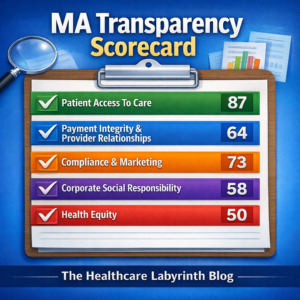
An MA Transparency Scorecard Is A Good Idea

NOTE: This blog is co-published in collaboration with Lilac Software. Learn more about Lilac’s Stars Analytics and Agentic AI solutions at https://lilacsoftware.com. A transparency scorecard could be adopted over time as a parallel initiative to promote better accountability Back on February 5, I did a blog that covered changes in the Medicare Advantage Star program and how things may transform even more. I covered the major changes in the Trump administration’s proposal to eliminate operational or administrative measures; proposals congressional policy arm MedPAC has made over the years; and a January 22 Health Affairs Forefront blog where a former Centers for Medicare and Medicaid Services (CMS) innovation official (Liz Fowler) and colleagues outlined their proposals for reform of Star. I noted that the influential Paragon Health Institute has also proposed some additional radical changes. See that detailed blog here: https://www.healthcarelabyrinth.com/could-even-more-medicare-advantage-star-changes-be-around-the-corner/ . In addition to endorsing the retirement of the administrative
Read More »
Logo

March 13, 2026

CMS All In On AI and Digital Health Centers for Medicare and Medicaid Services (CMS) Administrator Dr. Mehmet Oz championed the use of AI, agentic AI, and digital health at a recent healthcare tech conference. CMS is rapidly endorsing models to use such technology, and CMS is starting to use the technology too. Oz argued that such tech could help reduce rural healthcare gaps and that digital health and remote patient monitoring also could reduce costs by focusing care further upstream before diseases become acute. Oz argued: “I can win the battle for health, not in the ER or in the ICU, but in your home, in your kitchen, your bedroom, in your living room, with remote patient monitoring and better tools to validate that.” Seniors appear to be endorsing the technology too. A recent healthcare policy group KFF survey found that the vast majority of seniors are using digital

Read More »
Logo

March 12, 2026

New Poll Finds Unaffordability Having Consequences As we enter the midterms, healthcare affordability remains a significant challenge. A new poll finds that one in three Americans had to cut back on daily living expenses to afford care. A new West Health/Gallup survey says about a third of those surveyed cut back on at least one daily expense to afford healthcare last year. That is the equivalent of about 82 million Americans. For those that did not have insurance, about 62% said they made a cutback. For those with income of $24,000 or less, the tradeoff rate was about 55%. About 48% of those earning between $24,000 and $48,000 in annual household income said the same. In other news, a Modern Healthcare analysis finds that healthcare revenue rose faster than all other services categories in 2025. Increased prices and growing demand from an aging population drove much of this. Revenue tied

Read More »

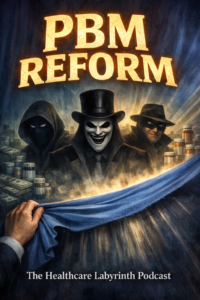
118. PBM Reform Explosion: What Just Happened — And What It Really Means

Trying to make sense of the recent PBM reforms and their significance? I map them in this podcast and what it really means? It is game-changing. About The Podcast: Millions of Americans feel confused and frustrated in their search for quality healthcare coverage. Between out-of-control costs, countless inefficiencies, a lack of affordable universal access, and little focus on wellness and prevention, the system is clearly in dire need of change. Hosted by healthcare policy and technology expert Marc S. Ryan, the Healthcare Labyrinth Podcast offers accessible, incisive deep dives on the most pressing issues and events in American healthcare. Marc seeks to help Americans become wiser consumers and navigate the healthcare maze with more confidence and certainty through The Healthcare Labyrinth website and his book of the same name. Marc is an unconventional Republican who believes that affordable universal access is a wise and prudent investment. He recommends common-sense solutions to reform

Read More »

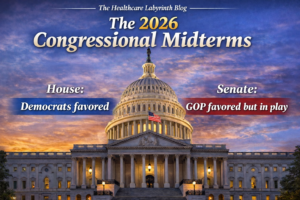
A Look At The Status Of Congressional Midterm Elections

House very likely to go Democratic with Senate in favor of GOP but increasingly in play A quick blog and a little off topic from my regular entries today. As many of you know, I have been involved in politics all my life – at the local, state, and national levels. I love taking periodic peaks at how elections are shaping up. In the past, I have offered my predictions on elections and today we will take a look at the status of the 2026 midterm elections for Congress in both chambers. My earlier prediction for 2026 midterms When I wrote my annual healthcare prediction blog for the coming year on December 31, 2025, I predicted the following for the 2026 midterms: (1) The Senate would maintain its GOP majority and have between 51 and 53 seats going into January 2027. Today’s Senate count is 53 for the GOP and

Read More »
Logo

March 11, 2026

Aetna Settles MA Risk Adjustment Case Aetna will pay $117.7 million to resolve False Claims Act allegations that it overbilled the Medicare program. The agreement settles claims related to past risk adjustment submissions in Medicare Advantage (MA). The Department of Justice said some diagnostic codes were not fully supported but were still submitted to secure higher payouts. Aetna also failed to withdraw some inaccurate diagnoses. Additional articles: https://www.modernhealthcare.com/insurance/mh-aetna-medicare-advantage-upcoding-claims/ and https://www.beckerspayer.com/payer/medicare-advantage/aetna-to-pay-118m-to-resolve-medicare-advantage-upcoding-allegations/ (Some articles may require a subscription.) #medicareadvantage #riskadjustment #overpayments #fwa https://www.fiercehealthcare.com/payers/aetna-pay-1177m-settle-medicare-advantage-false-claims-case-doj CMS Goes Hollywood On Fraud The Centers for Medicare and Medicaid Services (CMS) has gone Hollywood with glitzy ads bringing attention to fraud, waste, and abuse (FWA). The Trump administration has had some success. The Department of Justice reported a record $6.8 billion in settlements and judgments under the False Claims Act in the fiscal year that ended Sept. 30, 2025. #fwa #cms https://www.medpagetoday.com/special-reports/exclusives/120256 Researchers Track MA Diversity A

Read More »
Logo

March 10, 2026

Oz Says Exchanges Have Major Fraud Problem Centers for Medicare and Medicaid Services (CMS) Administrator Dr. Mehmet Oz claimed in his strongest terms yet that he believes major fraud exists in the Exchange enrollment process. He says millions could be inappropriately enrolled. Conservatives say the enhanced Exchange subsidies that have now expired led to millions being enrolled due to zero or near-zero premiums. A number of brokers have been accused of fraudulently enrolling Americans. In January, enrollment in the Exchanges dropped about 1 million, which is far less than estimates. Conservative groups, including the Paragon Institute, have argued that so-called “shadow enrollees” remain in the program. Oz did say he expects enrollment to drop throughout the year to around 19 million. In part this is because of affordability issues due to premium hikes and people being unwilling to pay any premium. #exchanges #coverage #fwa https://thehill.com/policy/healthcare/5776734-oz-claims-aca-fraud-millions JEC Piles On Regarding MA

Read More »
Logo

March 9, 2026

Balance And Bridge Proposed For GLP-1s The Centers for Medicare and Medicaid Services (CMS) has issued requests for applications for Medicare Part D plans and Medicaid agencies to join the BALANCE model that would bring GLP-1 weight-loss drugs to Medicaid and Medicare in 2026 and 2027, respectively, for those with obesity but not other qualifying disease states for the drugs. CMS will negotiate prices for such drugs with brand drug makers. Participating plans and Medicaid agencies must cover all model drugs from the included manufacturers, and the existing Part D weight-loss coverage exclusion would not apply. The drugs must fall under a plan’s basic benefit structure. In Part D, at least 90% of a plan’s eligible population must be included. Narrower risk corridors are available to plans. Enhanced alternatives and employer group waiver plans must cap beneficiary spending at $50 for a month’s supply during the initial coverage phase. For

Read More »

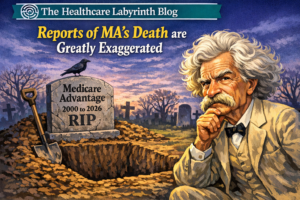
Reports Of MA’s Death Are Greatly Exaggerated

Medicare Advantage’s rocky road will smooth out in time with some political support While earlier pilots and the Medicare+Choice program lived before Medicare Advantage (MA), technically MA celebrated its 25th birthday recently. The Balanced Budget Amendment of 1997 created MA, with coverage starting in 2000. The 25th MA year began with insurers thinking better times were ahead when the pro-business and private healthcare Trump administration returned to power. Yet things didn’t quite turn out that way. What happened in 2025? All of this limits revenue in the future and the ability to use managed care principles to constrain costs. The fallout Actuarial and consulting firm Milliman finds that the average total value added continued to erode from 2025 to 2026, with total value added across general enrollment MA plans declining by more than 8%. The 2026 benefits marked the largest decline in MA.  As well, actuarial and consulting firm Wakely

Read More »
Logo

March 6, 2026

Health Systems Report Financial Strength Large health systems are on the upswing financially right now, with improved margins, higher volumes, investment returns, technology-driven efficiency, and better cash flow. In addition to the positives cited, health systems are also investing in alternative revenue streams, such as specialty pharmacy and outpatient care. But storm clouds are moving in. Pharmaceutical and supply costs have posted sharp increases. And health systems face financial hits from the Medicaid and Exchange cuts in the One Big Beautiful Bill Act (OBBBA). (Article may require a subscription.) #hospitals #margins #obbba https://www.modernhealthcare.com/providers/mh-health-system-earnings-kaiser-mayo-clinic Health Affairs Forefront Blogs On ACOs and ACCESS Health Affairs Forefront has published a number of blogs on Accountable Care Organizations (ACOs) and the Medicare tech-enabled chronic disease ACCESS model. In one blog, the main question is: “Do ACOs actually save Medicare money?” It notes that the Congressional Budget Office (CBO) has concluded, on average, they do not

Read More »

Available Now

$30.00