
rfkjr

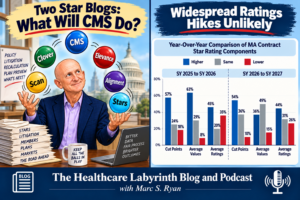
More Clover Lawsuit Fallout: The Balkanization of Star Ratings

More lawsuits and more Star rating scenarios in play Ok, so this is my fifth blog on the fallout from the Clover lawsuit decision, but continuing the saga is certainly merited. The Tukey outlier and guardrail decision in 2024 for SY 2024 Star Ratings certainly was defining in that plans won their point that the Centers for Medicare and Medicaid Services (CMS) was blatantly ignoring the regulatory process. Yet the Clover decision now appears to be going even farther in that Clover Health has exposed the fact that the Stars program as we have known it was not based in statute. More so, it now has created program uncertainty and the real chance that there may be no solid Stars foundation on which to calculate quality outcomes for the near future. Indeed, I am now characterizing what is occurring as the “balkanization of Star Ratings.” Let’s back up and give

Read More »
Logo

July 2-3, 2026

Paragon Proposes Reforms The influential Paragon Health Institute released a new report calling for federal funding cuts or tax reforms impacting all health plan lines of business and coverage areas. People pay attention to what Paragon says given its influence and impact on government regulations since 2025 as well as in the One Big Beautiful Bill Act (OBBBA). In summary, Paragon wants to see the following changes: #medicare #medicaid #exchanges #employercoverage #healthcarereform #healthcare #coverage https://paragoninstitute.org/medicare/restoring-fiscal-sustainability-to-federal-health-programs-reforming-the-incentives-that-drive-health-care-spending/ Balkanization of Star Ratings We are quickly seeing the balkanization of Star calculations for SY 2026. Elevance Health filed a suit against CMS today arguing that it should have used the Clover’s judge’s measures for recalculation rather than one created by the agency. Elevance says it lost out on $115 million in bonus payments as a result. Elevance has a point. How can one contract get the judge’s ruling while others receive the “better of”

Read More »

National Health Expenditure Data Continues To Show Crisis In Healthcare

NHED data continues to show the healthcare crisis The Centers for Medicare and Medicaid Services (CMS) Office of the Actuary released its projections for healthcare expenditure growth over the next decade, and it continues to show an alarming trend. Healthcare expenditures will grow well above increases in personal income and the gross domestic product (GDP). Setting the stage The CMS Actuary is the supreme authority on everything U.S healthcare. First, it is the main comprehensive source of data for calculating the history and future of healthcare spending. Most other studies rely in some form on the National Health Expenditure Data (NHED) reports. Usually in December of each year, the actuary reports on the details of healthcare spending in the prior year. Usually in June of each year, the actuary will forecast healthcare spending growth for the coming decade. Second, it is a treasure trove of data that helps explain the

Read More »
Logo

July 1, 2026

MA Star Bonus To Exceed $13B Healthcare policy group KFF reports that federal spending on Medicare Advantage (MA) quality bonuses will reach at least $13.4 billion in 2026, compared with $12.7 billion in 2025. This is more than four times higher than in 2015. More than two-thirds of Medicare Advantage enrollees (68%) are in plans that qualify for the quality bonus in 2026, down from 75% in 2025. This is the lowest since 2018. The increase ties to more enrollment not better ratings. In another briefer, KFF updates on MA coding intensity. Additional article: https://www.kff.org/medicare/decoding-medicare-advantage-coding-intensity/ #medicareadvantage #radv #riskadjustment #stars #quality #cms https://www.kff.org/medicare/medicare-will-spend-more-than-13-billion-on-the-medicare-advantage-quality-bonus-program-in-2026/ Home Health Hike For 2027 The Centers for Medicare and Medicaid Services (CMS) issued a proposed rule that would increase Medicare payments to home health providers by 2.4% in 2027. In addition, the rule would make it easier to bar providers and suppliers from Medicare over fraud. In

Read More »
Logo

June 30, 2026

House Wants To Rein In Private Equity A bipartisan House bill would require extensive reporting on private equity firms’ healthcare holdings and ownership structures. The reporting is aimed at identifying financial arrangements that may impact the financial health of the healthcare entity as well as impacts on healthcare delivery. The bill is similar to state laws on transparency in private equity. Other states have gone deeper and ruled out certain financial arrangements by private equity for acquired healthcare entities. (Article may require a subscription.) #healthcare #congress #privateequity https://www.modernhealthcare.com/politics-regulation/mh-private-equity-healthcare-congress-transparency Providers Direct Contract With Employers There is a growing trend in providers direct contracting with employers. Local networks are leveraged and providers avoid prior authorization and other administrative burdens. Both employers and providers are cutting out the insurance middleman. (Article may require a subscription.) #healthplans #employercoverage #providers https://www.modernhealthcare.com/providers/mh-northwell-commonspirit-direct-contracting-employers Providers May Get Changes For Quality Reporting A new bipartisan House bill would allow

Read More »
Logo

June 29, 2026

States Sue on Work Requirements Democratic governors and attorneys general from 25 states and Washington, D.C. are suing the Trump administration over the proposed Medicaid work requirements regulation. States argue the rule narrows exemptions for medically frail Medicaid beneficiaries and creates administrative barriers that could cause eligible people to lose coverage. The plaintiffs say the rule goes well beyond the statute by requiring people with serious health conditions to prove their condition significantly impairs their ability to meet work requirements. Additional: https://www.beckershospitalreview.com/legal-regulatory-issues/25-states-sue-trump-admin-over-medicaid-work-requirements-7-things-to-know/ and https://www.modernhealthcare.com/politics-regulation/mh-medicaid-work-requirement-lawsuit-democrats-bonta/ (Some articles may require a subscription.) #medicaid #workrequirements #states https://thehill.com/policy/healthcare/5946392-lawsuit-trump-medicaid-exemptions/ GLP-1 Bridge Population Healthcare policy group KFF finds that 3.8 million Medicare beneficiaries meet the criteria to be eligible for the new Medicare GLP-1 Bridge. The group looked at claims data from 2023. The proposed BALANCE program failed to attract enough plan participation. Instead, the Trump administration will run Bridge from July 2026 to Dec 2027.

Read More »

May to June 2026 Medicare Advantage Enrollment

June enrollment growth slows, but SNPs surge In a February 16 blog, I detailed the growth in Medicare Advantage (MA) from February 2025 to February 2026 after a delay from the Centers for Medicare and Medicaid Services (CMS) in posting the annual data. As I noted, the January enrollment statistics in both years seemed off so many analysts are comparing February to February each year. Each month since then I have updated with monthly growth numbers. Now, we have June results. For those who may have missed earlier blogs, I am refreshing on some of the annual results. The annual statistics show some of the financial struggles the industry continues to have. Growth is way down compared with prior years in the 2020s due to major geographic contractions as well as plan benefit reductions by major MA players the past few years. As the chart below shows, February 2025 to

Read More »
Logo

June 26, 2026

Exchange Enrollment Falls Dramatically A number of analyses have predicted that Exchange enrollment nationally will fall in 2026 after dropping from 24.3M in 2025 to 23.1 in January 2026. The analyses said that enrollment would drop to as low as 17.5M as people would not be able to afford their premiums throughout the year. Sure enough, the predictions seem to have come true, and the news may be being buried. Today, a Health and Human Services (HHS) website posted an analysis on fraudulent and phantom enrollments and deep in the release were latest enrollment figures. HHS says around 19.2 million people are enrolled in the Exchanges as of now, a drop of about 4M since January. HHS says millions are inappropriately receiving subsidies, including individuals misstating their income to gain access to free plans and phantom enrollees (those who are unknowingly enrolled in free plans by unscrupulous brokers or are

Read More »
Logo

June 25, 2026

Cassidy Wants 340B Reform Sen. Bill Cassidy, R-LA, unveiled a draft for 340B reform today and challenged the public to offer comments for the possible passage of legislation later in the year. This would be the first time any statutory changes to 340B would be made in 15 years. There are numerous reforms aimed at controlling costs, reining in inappropriate use of the program, reducing duplicative discounts, and ensuring savings are actually passed through to needy consumers. The hospital lobby and others oppose any changes. Numerous studies show that 340B hospitals tend to have higher prices than non-340B ones. Changes would include the ability of drug makers to offer upfront discounts or retrospective rebates, claims submission, and mandatory pass-through of the rebates. There would also be a set number of contract pharmacies within each geographic region that a qualifying provider could have. Additional article: https://www.fiercehealthcare.com/providers/cassidys-new-plan-reform-340b-rebates-contract-pharmacy-limits-and-more (Some articles may require a

Read More »

MedPAC Examines Medicare Enrollment’s Mind-Boggling Complexity

The process shows the need for healthcare reform I am not the biggest fan of MedPAC, the congressional Medicare policy arm. For example, I have taken issue with what I think is its slanted views on Medicare Advantage (MA) overpayments. But recently, I did give it some credit on its look at hospital financial health when MA penetration increases. It was a balanced look and concluded that MA penetration is not tied to financial instability as some hospital lobbies suggest. Empirical analyses conducted by MedPAC staff showed no evidence of a significant association between MA market penetration and all-payer margins of hospitals, skilled nursing facilities (SNFs), and home health agencies. Negative impacts do not appear to be the case in rural markets, either. That is Chapter 3 of the MedPAC report (link at end of the blog). I will likely write more about this soon. My real reason for writing

Read More »

Available Now

$30.00