rfkjr

Logo

May 22, 2026

Feds To Use AI To Audit States The Department of Health and Human Services (HHS) will use artificial intelligence to review state audits of federal funding recipients, including Medicaid agencies. HHS told governors that its new Audit Enforcement and Risk Oversight initiative will review the previous five years’ worth of audits of state agencies. The agencies are required to conduct audits of state programs and grantees if expenditures of federal funds are over $1 million. (Article may require a subscription.) #fwa #trump #hhs https://www.modernhealthcare.com/politics-regulation/mh-hhs-ai-medicaid-audit-states-funding Point32Health Reports Q1 Profit Turnaround Point32Health reported an adjusted net income of $248 million in Q1 2926, a reversal from a $21 million adjusted net income in Q1 2025. Point32Health is the Harvard Pilgrim Health Care and Tufts Health Plan parent. #healthplans #margins https://www.beckerspayer.com/financial/point32health-posts-86m-operating-income-in-q1/ — Marc S. Ryan

Read More »
Logo

May 21, 2026

340B Hospital Lawsuit: The Pot Calling The Kettle Black Three health systems – Mount Sinai in New York, Michigan Medicine, and University of Kansas City Health — have filed federal lawsuits against CVS Health. The hospitals allege that CVS and sister companies diverted about $250 million from 2020 and 2025 in savings generated through the 340B drug pricing program. The 340B program requires brand drug makers to offer discounted prices to hospitals and safety net providers. Oftentimes, various healthcare entities are part of the adjudication and documentation process. The complaint alleges that CVS health companies used a series of intercompany service transactions to divert the funds and retain them when they should have been given to the hospitals. I have argued that vertically integrated companies use all sorts of inter-company transfers to retain dollars within the family. So, I don’t doubt that what is alleged is possible. At the same time,

Read More »

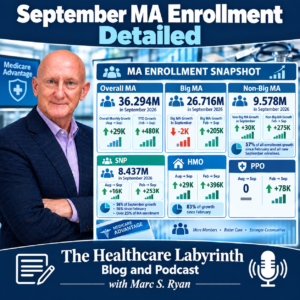
April to May 2026 Medicare Advantage Enrollment

May enrollment bounces back In a February 16 blog, I detailed the growth in Medicare Advantage (MA) from February 2025 to February 2026 after a delay from the Centers for Medicare and Medicaid Services (CMS) in posting the annual data. As I noted, the January enrollment statistics in both years seemed off, so many analysts are comparing February to February each year. On March 30, I updated my blog site with results for March 2026. On April 20, I updated my blog site with results for April 2026. Now, we have May results. For those who may have missed the earlier blogs, I am refreshing on some of the annual and early 2026 results. The annual statistics show some of the financial struggles the industry continues to have. Growth is way down compared with prior years in the 2020s due to major geographic contractions as well as plan benefit reductions

Read More »
Logo

May 20, 2026

Second Provider Tax Rule Issued Under OBBBA Under a proposed rule implementing aspects of the One Big Beautiful Bill Act (OBBBA) Medicaid reductions, state-directed payments would be capped at 100% of Medicare rates in states that expanded Medicaid and 110% in non-expansion states. The rule saves more than $775 billion over 10 years, including $510 billion in federal savings. Another rule that was finalized in April ends states’ ability to use certain provider taxes to generate additional federal Medicaid matching funds. That rule bans states from imposing higher tax rates on Medicaid business than on non-Medicaid business and blocks indirect tax structures designed to bypass those limits. The proposed rule would apply to hospital inpatient and outpatient services, skilled nursing facility services, and qualified practitioner services at academic medical centers. The policy would be expanded to all services in 2029. Certain payments are temporarily grandfathered, although they will be reduced

Read More »
Logo

May 19, 2026

Exchange Enrollment Likely To Decline By Millions This Year Healthcare policy group KFF finds that enrollment in Exchanges could decline to 17.5 million people this year. About 23.1 million enrolled as of January 1, which was already down from 2025 by 1.2 million. KFF used data from a Wakely Consulting study. Just 86% of people enrolled in an individual market plan as of January 2026 paid their first month’s premium. If such trends continue, enrollment in the Exchanges could decrease between 17% to 26% over the course of 2026. The fall would include future unpaid premiums, mid-year attrition, and other impacts. KFF also looked at all the cost impacts of expiring premium studies. Earlier it estimated that premiums would increase 114% if all enrollees stuck with their same plan. The new analysis finds that premiums in the aggregate actually increased by 58% for enrollees, which accounts for people switching to

Read More »
Logo

May 18, 2026

More Drugs On TrumpRx President Trump announced that more than 600 generic drugs will be available through the TrumpRx website and billionaire entrepreneur Mark Cuban of Cost Plus Drug was there to celebrate with him. Some are critical of the initiative, arguing that lower prices may be available through insurance or elsewhere. But there is no denying that Trump’s many drug price reform initiatives are redefining drug price in the nation. #drugprices #trump https://thehill.com/policy/healthcare/5884064-trump-adds-600-generic-drugs Cassidy Loses Primary Health, Education, Labor and Pensions (HELP) Committee Chair and Sen. Bill Cassidy, R-LA, lost his primary battle by coming in third, which means he is out as a senator next year. President Trump endorsed a conservative congresswoman in the primary given Cassidy’s contentious relationship with the White House. This will mean a new Senate healthcare head is in the cards for 2027 whether or not the GOP keeps control. #congress #midterms #healthcare https://www.fiercehealthcare.com/regulatory/senate-help-chair-bill-cassidys-primary-loss-casts-congressional-health-policy

Read More »

2027 ACA Exchange Rule Signals Paradigm Shift

Even more innovation would be welcome Readers of this blog will know that I am on a bit of a transformation in terms of how I view coverage. I have always been a comprehensive coverage guy. I have backed reasonable subsidies as well as coverage that ensures people to access primary care and prevention upfront. But the problem is that coverage and benefit design in this country appear to be more broken than not. I recently have made the argument that coverage and strong benefits on paper do not mean people can truly access healthcare benefits with massive repercussions for people’s health and the nation’s quality statistics. I think this will continue to be true and almost certainly worsen if we do not reform price. And there is good reason to believe that even if we did reform price, looking at newer models to incentivize primary care and prevention should

Read More »
Logo

May 15, 2026

CMS Finalizes Sweeping Exchange Rule The Centers for Medicare and Medicaid Services (CMS) finalized its sweeping 2027 Affordable Care Act and Exchange rule today. While a few items were not finalized, most of the major items that will dramatically change offerings were. The agency says the rule is an effort to bring down premiums, increase choice, and address fraud. Critics say it will erode enrollment and benefits. The changes include: (Article may require a subscription.) #exchanges #aca #obamacare #trump #regulations #coverage #healthcare https://www.modernhealthcare.com/politics-regulation/mh-cms-aca-exchange-rule-2027-final Plans, Providers Want A Targeted Fraud Approach In response to a request for information on stemming fraud in government programs, providers and payers are each urging some caution. Providers say the Centers for Medicare and Medicaid Services (CMS) should move cautiously to implement its anti-fraud strategy rather than apply a uniform approach across the board. They want reforms focused on high-risk activities so as not to further

Read More »
Logo

May 14, 2026

Internal CMS Memo Shows Growing Exchange Falloffs NOTUS obtained an internal Centers for Medicare and Medicaid Services (CMS) memo that says more Americans are dropping out of Exchange coverage than usual. The memo says more than one in five people who enrolled in health insurance through the federal Exchanges during open enrollment and in the weeks following were dropped from coverage for failing to pay their first month’s premium. This rate is significantly higher than the rate from last year, which was 12%. The administration attributes most of the drop to efforts to root out fraud. That could be some of it, but companies also report dropping enrollment since January due to non-payment. Premiums surged when enhanced subsidies lapsed. This occurred for those subsidized as well as more generally as companies increased rates across the board to mitigate an anticpated increase in risk and surging utilization costs. (Article may require

Read More »

Health Plans’ Stocks Soar; So, Is All Well?

Health plans have plotted a comeback and so far it is working Q1 offered a cautiously encouraging picture for the U.S. health insurance sector. After a bruising couple of years marked by elevated utilization, Medicare Advantage (MA) margin compression, and policy disruption, most large plans are reporting improved financial performance. Stocks soared as a result. So, is plan financial health back? Well, not so fast. The positive financial performance is more a result of low expectations and plans are still, like Sisyphus, pushing a huge boulder up a hill. And given trends, it could very well come rolling back down. There was a literal financial meltdown at some plans beginning as early as 2024. Some of this was caused by external factors. But a great deal of it, too, was due to a lack of discipline by plans in multiple areas – finance, quality, and operations. It was an embarrassment

Read More »

Available Now

$30.00