regulations

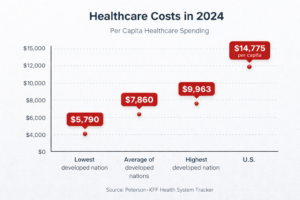
Healthcare Spending Comparison

More confirmation of America’s excessive spending on healthcare A short blog today to update you on healthcare spending around the developed world based on a new Peterson-KFF Health System Tracker chart collection recently published. I have covered this topic of spending and quality in the past many times. What did Peterson-KFF find last time on costs? In the earlier analysis, Peterson-KFF found the following: What did Peterson-KFF find last time on quality? Peterson-KFF finds that the U.S. performs worse in long-term health outcomes measures (e.g., life expectancy), certain treatment outcomes (e.g., maternal mortality and congestive heart failure admissions), some patient safety measures, and health system capacity. On the other hand, the U.S. performs similarly to or better than peer nations in other measures of treatment outcomes (e.g., mortality rates within 30 days of hospital admission) and some patient safety measures (e.g., post-operative complications). In essence, if you have good access


Read More »

February to March 2026 Medicare Advantage Enrollment

February to March enrollment grows after dismal enrollment season In a February 16 blog, I detailed the growth in Medicare Advantage (MA) from February 2025 to February 2025 after a delay from the Centers for Medicare and Medicaid Services (CMS) in posting the annual data. As I noted, the January enrollment statistics in both years seemed off so many analysts are comparing February to February each year. To summarize, the annual statistics show some of the financial struggles the industry continues to have. Growth is way down compared with prior years in the 2020s due to major geographic contractions as well as plan benefit reductions by major MA players the past few years. As the chart below shows, February 2025 to February 2026 enrollment growth was just 2.5% — way down from annual growth from January 2020. Now we have statistics for March 2026. MA enrollment continues to grow due

Read More »

States Attack Healthcare Costs and Hospital Prices

Since the feds won’t act, states seeking to limit healthcare costs I have made the case that healthcare reform is largely frozen at the national level — with neither party really willing to tackle the root causes of healthcare’s costs. Republicans line up to skinny down benefits, while Democrats advocate for greater and greater subsidies. While I support universal access and tackling the affordability crisis with experimentation, price reform (teamed with primary care and prevention and affordable universal access), is the core of true reform. Under Trump 45, the administration sought to make some meaningful incremental reforms, only to have them reversed by the Biden administration. Trump 47 has come back with some of the same reforms: In the end, these are indeed modest reforms and Congress appears reluctant to truly jump into the fundamental issue of price. That is why states have begun doing their best to tackle prices

Read More »

Oz’s Agenda At CMS

Oz’s CMS looks very different Two major healthcare conferences recently occurred – the HIMSS conference in Las Vegas followed by the Centers for Medicare and Medicaid Services (CMS) Quality Conference the next week. CMS Administrator Dr. Mehmet Oz spoke at both conferences and Oz and other top sister agency officials discussed the Trump administration’s vision for healthcare. Suffice it to say that the Trump CMS is vastly different in tone and philosophy than Biden’s CMS. Furthermore, while themes and approaches were similar between Trump 45 and 47, you can say that Trump 47 is on steroids when it comes to grand visions and efforts to implement change. It is both the personality and drive of Oz as well as President Trump now understanding government and what it takes to implement change. If Trump 45 was incremental and conservative in approach, Trump 47 is far more aggressive and swift. At the

Read More »

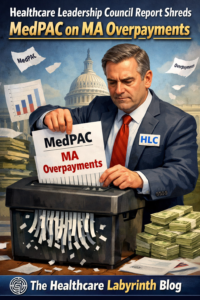
HLC Report Shreds MedPAC On MA Risk Adjustment And Overpayments

Congress should take note of a report that rips apart MedPAC’s sometimes biased analyses In my March 9 blog on the great exaggeration of the death of Medicare Advantage (MA), I told you about a recent opinion piece by former Health and Human Services secretaries Donna Shalala and Tommy Thompson supporting MA and questioning analyses by congressional Medicare policy arm MedPAC. In it they refer to the Healthcare Leadership Council’s (HLC) September 2025 report that literally ripped apart the government advisory entity’s MA analyses. For years, I have been saying MedPAC as well as many academics have clear anti-MA bias. Their analyses are flawed and use old data to confuse the public and lawmakers. I have cited studies that stand in stark contrast to these biased analyses. But the HLC’s report, titled “Setting the Record Straight: The Fact’s Behind MedPAC’s Misleading Cost Analysis of Medicare Advantage,” is perhaps the most

Read More »

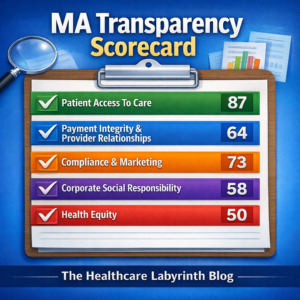
An MA Transparency Scorecard Is A Good Idea

NOTE: This blog is co-published in collaboration with Lilac Software. Learn more about Lilac’s Stars Analytics and Agentic AI solutions at https://lilacsoftware.com. A transparency scorecard could be adopted over time as a parallel initiative to promote better accountability Back on February 5, I did a blog that covered changes in the Medicare Advantage Star program and how things may transform even more. I covered the major changes in the Trump administration’s proposal to eliminate operational or administrative measures; proposals congressional policy arm MedPAC has made over the years; and a January 22 Health Affairs Forefront blog where a former Centers for Medicare and Medicaid Services (CMS) innovation official (Liz Fowler) and colleagues outlined their proposals for reform of Star. I noted that the influential Paragon Health Institute has also proposed some additional radical changes. See that detailed blog here: https://www.healthcarelabyrinth.com/could-even-more-medicare-advantage-star-changes-be-around-the-corner/ . In addition to endorsing the retirement of the administrative

Read More »

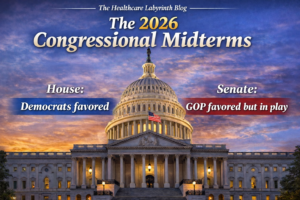
A Look At The Status Of Congressional Midterm Elections

House very likely to go Democratic with Senate in favor of GOP but increasingly in play A quick blog and a little off topic from my regular entries today. As many of you know, I have been involved in politics all my life – at the local, state, and national levels. I love taking periodic peaks at how elections are shaping up. In the past, I have offered my predictions on elections and today we will take a look at the status of the 2026 midterm elections for Congress in both chambers. My earlier prediction for 2026 midterms When I wrote my annual healthcare prediction blog for the coming year on December 31, 2025, I predicted the following for the 2026 midterms: (1) The Senate would maintain its GOP majority and have between 51 and 53 seats going into January 2027. Today’s Senate count is 53 for the GOP and

Read More »

Reports Of MA’s Death Are Greatly Exaggerated

Medicare Advantage’s rocky road will smooth out in time with some political support While earlier pilots and the Medicare+Choice program lived before Medicare Advantage (MA), technically MA celebrated its 25th birthday recently. The Balanced Budget Amendment of 1997 created MA, with coverage starting in 2000. The 25th MA year began with insurers thinking better times were ahead when the pro-business and private healthcare Trump administration returned to power. Yet things didn’t quite turn out that way. What happened in 2025? All of this limits revenue in the future and the ability to use managed care principles to constrain costs. The fallout Actuarial and consulting firm Milliman finds that the average total value added continued to erode from 2025 to 2026, with total value added across general enrollment MA plans declining by more than 8%. The 2026 benefits marked the largest decline in MA.  As well, actuarial and consulting firm Wakely

Read More »

Major Developments On The Medicare Advantage Compliance Front

HHS OIG and CMS up ante on compliance There have been a number of important developments on the Medicare Advantage (MA) compliance front over the past few months. These include the release of a guidance document from the Department of Health and Human Services (HHS) Office of Inspector General (OIG) on compliance as well as the Centers for Medicare and Medicaid Services’ (CMS) 2026 program audit protocol updates. Overview of the MA-ICPG The Medicare Advantage Industry Segment-Specific Compliance Program Guidance (MA-ICPG) is a voluntary, non-binding guidance document from the HHS OIG. The document can be found here: https://oig.hhs.gov/compliance/ma-icpg/ . The guidance is meant to help MA plans and other entities to identify and mitigate compliance risks. The February 2026 guidance updates prior guidance from 1999. It is not meant to overrule or replace OIG’s separate General Compliance Program Guidance (GCPG) or CMS’s compliance program regulations for MA that can be

Read More »

Affordability Studies Summarized

Studies on affordability show the crisis in America With affordability dominating the headlines and healthcare as high as number two in midterm election polls, I wanted to do a quick blog on recent healthcare affordability studies – some of these previously mentioned in these pages. KFF Employer Survey Healthcare policy group KFF annually surveys employers on healthcare cost trends. The survey released in October showed the recent trend of huge surges in utilization and overall employer costs for healthcare. KFF found the following: Rice University/Baylor College of Medicine Researchers from Rice University and Baylor College of Medicine looked at worker contributions to employer coverage over time. It found the following: The Commonwealth Fund The Commonwealth Fund analyzed national data from 2024. It found the following: KFF on non-employer Exchange coverage KFF looked at the impact of the expiration of the enhanced premium subsidies at the end of 2025 on overall

Read More »

Available Now

$30.00