nhed

A Look At The Status Of Congressional Midterm Elections

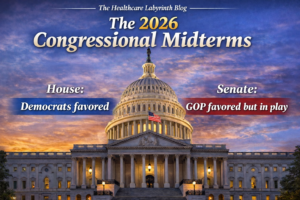
House very likely to go Democratic with Senate in favor of GOP but increasingly in play A quick blog and a little off topic from my regular entries today. As many of you know, I have been involved in politics all my life – at the local, state, and national levels. I love taking periodic peaks at how elections are shaping up. In the past, I have offered my predictions on elections and today we will take a look at the status of the 2026 midterm elections for Congress in both chambers. My earlier prediction for 2026 midterms When I wrote my annual healthcare prediction blog for the coming year on December 31, 2025, I predicted the following for the 2026 midterms: (1) The Senate would maintain its GOP majority and have between 51 and 53 seats going into January 2027. Today’s Senate count is 53 for the GOP and

Read More »

Reports Of MA’s Death Are Greatly Exaggerated

Medicare Advantage’s rocky road will smooth out in time with some political support While earlier pilots and the Medicare+Choice program lived before Medicare Advantage (MA), technically MA celebrated its 25th birthday recently. The Balanced Budget Amendment of 1997 created MA, with coverage starting in 2000. The 25th MA year began with insurers thinking better times were ahead when the pro-business and private healthcare Trump administration returned to power. Yet things didn’t quite turn out that way. What happened in 2025? All of this limits revenue in the future and the ability to use managed care principles to constrain costs. The fallout Actuarial and consulting firm Milliman finds that the average total value added continued to erode from 2025 to 2026, with total value added across general enrollment MA plans declining by more than 8%. The 2026 benefits marked the largest decline in MA.  As well, actuarial and consulting firm Wakely

Read More »

Major Developments On The Medicare Advantage Compliance Front

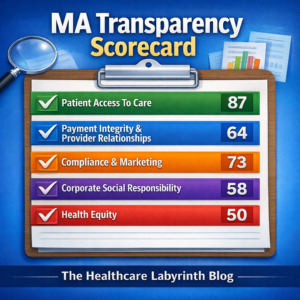
HHS OIG and CMS up ante on compliance There have been a number of important developments on the Medicare Advantage (MA) compliance front over the past few months. These include the release of a guidance document from the Department of Health and Human Services (HHS) Office of Inspector General (OIG) on compliance as well as the Centers for Medicare and Medicaid Services’ (CMS) 2026 program audit protocol updates. Overview of the MA-ICPG The Medicare Advantage Industry Segment-Specific Compliance Program Guidance (MA-ICPG) is a voluntary, non-binding guidance document from the HHS OIG. The document can be found here: https://oig.hhs.gov/compliance/ma-icpg/ . The guidance is meant to help MA plans and other entities to identify and mitigate compliance risks. The February 2026 guidance updates prior guidance from 1999. It is not meant to overrule or replace OIG’s separate General Compliance Program Guidance (GCPG) or CMS’s compliance program regulations for MA that can be

Read More »

Affordability Studies Summarized

Studies on affordability show the crisis in America With affordability dominating the headlines and healthcare as high as number two in midterm election polls, I wanted to do a quick blog on recent healthcare affordability studies – some of these previously mentioned in these pages. KFF Employer Survey Healthcare policy group KFF annually surveys employers on healthcare cost trends. The survey released in October showed the recent trend of huge surges in utilization and overall employer costs for healthcare. KFF found the following: Rice University/Baylor College of Medicine Researchers from Rice University and Baylor College of Medicine looked at worker contributions to employer coverage over time. It found the following: The Commonwealth Fund The Commonwealth Fund analyzed national data from 2024. It found the following: KFF on non-employer Exchange coverage KFF looked at the impact of the expiration of the enhanced premium subsidies at the end of 2025 on overall

Read More »

Trump’s SOTU Gives Short Shrift To Healthcare Affordability

Five minutes on healthcare in marathon speech President Donald Trump’s State of the Union (SOTU) address was long but actually gave short shrift to the issue of healthcare affordability. In truth, the administration has been very active on healthcare, which made the fact that healthcare was mentioned for just five minutes in the lengthiest SOTU ever (so we think) odd. We know that healthcare affordability certainly resonates with voters and continues to be among the top issues on voters’ minds. Cost of living, inflation, and the economy appear to be the top issue in polls, with healthcare costs and access right behind it. In truth, healthcare affordability is now a cost-of-living issue as about 10% of monthly family budgets are consumed by healthcare costs. Healthcare is a key worry for the public. Republicans are hurting on the issue. Voters tend to give the Democrats better numbers when asked who would

Read More »

MA Overpayments Remain Controversial, But Could Part Of The Argument Be Going Way

With v28, coding intensity has come down, now there is the debate on favorable selection For years MedPAC and opponents of Medicare Advantage (MA) have been touting studies that say MA rates are entirely too high. The healthcare and mainstream press have picked up on the claims. The same is true for Capitol Hill. But at least some of the winds will be taken out of the sails of MedPAC and MA opponents due to a new risk model that has been implemented. The realignment Much to MA plans’ chagrin, back in 2024 the Centers for Medicare and Medicaid Services (CMS) began implementing v28 of the risk adjustment model. The model essentially reforms the risk adjustment process by changing how diagnosis codes map to risk-adjusted payments. CMS removed a large number of previously payable diagnosis codes and changed how some conditions are weighted, aiming to better reflect true health cost

Read More »

Confused About Recent PBM Changes And Proposals – Here Is My Shot At Demystifying It

Major activity on PBM front that will help redefine drug pricing and costs There have been major headlines recently about impending pharmacy benefits manager (PBM) reforms. Many are asking: “What changes have occurred and what are the impacts?” Frankly, so much is going on that it was hard to make any sense of it. So, I sat down to take my best shot at cataloguing and explaining the recent developments. Here is my quick take of the major developments broken up in these buckets (I like to talk about buckets to keep it all straight) – (1) FFY 2026 Bill; (2) Future Capitol Hill Reforms; (3) The FTC Settlement; (4) Express Scripts’ Net Price Announcement; and (5) Drug Price Reform Proposals. The FFY 2026 Appropriations Bill The recent compromise to fund FFY 2026 had major PBM reforms. It was the first major bill on PBM changes in several years –

Read More »

2026 Medicare Advantage Enrollment Season Report

While enrollment growth slowed, results show the staying power of Medicare Advantage After a long delay, the Centers for Medicare and Medicaid Services (CMS) finally published results for January and February for Medicare Advantage (MA). While many predicted that the program would contract, I had said that enrollment would be flat or one of the lowest growths we had seen recently. Some analysts suggested that there would be a decline because of the mass exodus of large plans from certain markets and efforts by them to shed huge amounts of enrollment. The idea was that other plans could not pick up the slack and exits in certain counties would have left few opportunities for plans to find alternatives in MA. But despite the huge challenges in the program, MA showed some resiliency. Yes, enrollment growth was way down, but it did not contract as some had predicted. It very much

Read More »

The 2027 ACA Exchange Rule – The Good and Bad

Critics question the changes, but doesn’t something have to be done to tackle affordability It is hard to digest all the ramifications of the Trump administration’s proposed 2027 Affordable Care Act (ACA) Exchange rule. The proposal was issued just this week and the rule is voluminous – it is 195 pages in small font PDF form! But here goes my best take on some of the changes proposed by the Trump administration on the benefit and coverage front under the Affordable Care Act (ACA) on and off the Exchanges. These changes are seminal and mark a major change from the philosophy of the Obama and Biden administrations. They build on changes under regulations during Trump 45, regulations finalized by Trump 47 in 2025, as well as in the One Big Beautiful Bill Act (OBBBA). Hopelessly devoted to generous benefits and subsidies As some background on the Obama and Biden years,

Read More »

Is Value-Based Care Really Making A Difference or Not?

Detractors say no, but at maturity VBC/VBP offers hope in concert with other reforms A recent Health Affairs Forefront Blog challenged popular wisdom on the potential of value-based care (VBC) and value-based payments (VBP). According to the authors of the January 23 blog, value-based payments (VBP) and managed care will not solve the ongoing affordability crisis in healthcare. While some of the authors’ points are not wrong (including other root causes to high costs), I feel like they failed to consider the transformational journey we are on. So, let’s dig into the topic. What is VBC/VBP? VBC payments are meant to move from the fee-for-service (FFS) transactional payment system to one driven by efficiency and quality. What do I mean by transaction payments? For the past many decades, most payments in our healthcare system were made as a fee for each service transacted in the healthcare system. That can be

Read More »

Available Now

$30.00